Wednesday, 15 October 2014

Crazy spring work

Crazy spring work

It’s a very exciting but very busy time of year with all the breeding species returning, so here’s a quick update on what’s going on on Bird Island.


Giant Petrels

As detailed a few entries back, working with the giant petrels is one of my main tasks. From 10th September I’ve been out every day walking back and forth over the study area, looking for new nests and recording information on the breeding birds. The northern geeps have almost all laid now, over 300 nests marked and pairs recorded, and the southerns are about to start.

Not my favourite nest location to check, though I can’t fault the view.

It’s great to see such a range of personalities in these birds; from nervous young ones who defend their patch with extreme aggression to calm old ones who tolerate your presence. Some of the latter are older than me while there’s a few new breeders who, although 6 to 8 years old, are on their first egg.

The advantage of nesting early is that the chicks will be born when food is at its most abundant as there will be plenty of vulnerable young seals and penguins. The disadvantage is that there can still be a bit of snow.

Checking all these birds has meant a few long days in the field, especially when I’ve a few other bits and pieces to do. Up to seven hours with only a brief lunch break and then two hours of data entry in the evenings is not unusual. That’s the nature of the job – when the work’s there you do it, when it’s not you try and relax a little.

A cold day on the geep round.


Penguins

Preparations for the return of the macaronis has focussed on setting up the weighbridge – the extremely clever system that weighs each and identifies each tagged individual on its way in and out of the colony. There’s a whole system of electronics that were taken in at the end of winter that needed to be reassembled and tested. After a few little issues that seems to be working and I’m excitedly waiting for the first birds due back this week.

Gentoos returning from the ocean to their breeding grounds.

The gentoos have been around in varying numbers all winter, often hanging round their nests and adding a few stones to it, but once the snow and ice disappeared they started building with real purpose. They collect as many pebbles as they can, supplemented by bits of bone and tussac and make a pile before pushing with their feet to hollow it out into a bowl in which they lay two large, white eggs. The first few are on eggs now and at two of the colonies I’ve mapped a combined 70 nests that I’ll follow the build up of. From this we’ll establish the peak laying date and hence when I need to do all the colony nest and chick counts.

Copulating pair of gentoos. There is a lot of bill-tapping and the male (on top) patting the female’s flanks with his wings.


Albatrosses

The wanderer chicks are very well developed, with many showing only the remnants of their downy chick feathers. They’re stretching their wings out and flapping hard and it’ll not be long before they’re jumping up in the strong winds, getting a bit of a lift before fledging properly in a month or two.


Cosy pair of grey-headed albatross.

The smaller albatrosses – the grey heads, black brows and light mantled sooties - are all back around their colonies too with the former already on eggs. Jess, the albatross assistant, has been out every day recording ring numbers of the birds and marking each of the nests.


White-chinned petrels

One of the joys has been the return of sound to Bird Island – the singing pipits, honking albatross and chattering petrels. While it’s great to see the white chins soaring around the colonies during the day it’s hearing them through the open window when I go to bed at night that’s the real treat.


Seals

Cian’s daily leopard seal round continues and although there’s only one regularly seen lep around at the moment he’s given us a lot of special moments. Not least recently when he made a spectacular meal out of a king penguin.

Gill thrashing an unfortunate king penguin.

While we’ll be waiting another month for the first seal puppy we’ve got our first baby in the form of an elephant seal pup. Several in fact. They’re not regular Bird Island breeders but we’re lucky enough to have one very close to the base. We noticed it almost as soon as it was born, before the hungry skuas noticed in fact and started hanging around, trying to pinch the placenta and afterbirth. In a day or two the pups have put on so much weight already it’s incredible.

Shortly after being born the first puppy screams for attention while skuas and a giant petrel wait for anything worth scavenging.

An elephant seal family? Or a mum and pup trying to get away from a huge, randy male?

There have been a handful of large male elephant seals hanging round the last few weeks and we’ve seen a few confrontations and short fights in the water. Seeing them rear up and bellow is an amazing sight. When they utter their deep, bass roar it reverberates off the hills and seems to shake the whole base.

Bellowing male elephant seal.


Visitors

The American ship the Nathaniel B. Palmer came by with a group installing a GPS station. This was on one of the wettest days of the year and they had to navigate round a huge male ellie seal that had taken up residence on the jetty. But everything went smoothly – we all pitched in with carrying scaffolding, batteries, electronics and tools up the hill. The route up, normally a stream, had turned into a bit of a torrent and despite the best efforts of our waterproofs there was no chance of staying dry. Those at the top did valiant work, staying up there all day until the job was done while we were able to show off a few penguins and albatrosses to the others.
Despite our initial reservations about talking to other people after seven months of the same three faces, communications proved easy and they were a very friendly bunch. They endeared themselves even more by bringing a few trays of fresh fruit, veg and eggs. Colourful, crunchy and tasty peppers, tomatoes and bananas! You know you’re missing out when celery is seen as a treat.

Jerry Gillham

Saturday, 23 August 2014

I come from the land of ice and snow.


 The last week has brought us the coldest weather I've so far experienced down south with it touching -10C. Add to that the 30 knot winds and it's been pretty chilly. Normally I head out just wearing a t-shirt under my paramo jacket but yesterday I had a thermal, thin jumper and fleece under there. I was plenty warm enough, except on the fingers when photographing the ice and snow.

Using the bridge on one of the few times it's fine not to.
Looking across the bay to base, with ice forming everywhere.

It tends to move through in blizzards, some lasting all day, some just a few minutes, punctuated by moments of sunshine. I chose one of these bright moments to carry a load of path-marking stakes up the hill (though it's clearly too frozen to drive them in so they're in a pile waiting for it to thaw), by the time I'd reached the top it was clear and the sun was bouncing off the snow, but within a few minutes I was in the middle of a snowstorm. By the time I'd made my way down it was again clear, though the clouds over South Georgia indicated this wouldn't be for long.

Sun on base but some ominous clouds approaching. 
Wonderful clear views across Bird Island and South Georgia.

As the temperature really began to drop we got ice forming in the bay. Just mush at first and a bit of pancake ice, but the really impressive bits are the rocks and seaweed that get covered with hard ice where the sea's been washing over them.

The incoming tide rising over ice-covered rocks.

Pancake ice forming around the jetty.

A highlight of the winter was the appearance in the bay of three snow petrels. These breed high up on the South Georgia mainland and are infrequently seen here on Bird Island, usually fleeting glimpses of them high over the peaks. But there they were, along with dozens of terns, picking morsels out of the ocean – crustaceans or possibly carrion from a leopard seal dinner.

Terns coping with the polar ground.

Antarctic Tern fishing in the forming ice.

Beautiful Snow Petrel.


When the weather allows we've been out ringing wandering albatross chicks. This a major part of the long term monitoring of this vulnerable species. They travel so far they can pitch up anywhere across the southern ocean, though many of them will (hopefully) return to breed on Bird Island in around eight years time.

Wandering Albatross chicks.

Wednesday, 6 August 2014

Lord of the Bird Rings

The past weekend saw the annual Antarctic 48-hour Film Festival.

I wrote about this last year and our 2013 entry is available here.

Every base on the continent and the sub-Antarctic islands is invited to make and submit a short film, shot entirely on location and over a two-day period. To keep things fair and fresh there are five elements given out on the Friday that have to be included in every film; two objects (this year a swimsuit and a swing), a sound effect (a pig squeal), a character (Wal Footrot – a New Zealand cartoon character who was fairly simple to google) and a line of dialogue. As we'd been voted best screenplay for our condensed Star Wars tribute last year we got to supply the latter, and after much sorting through Smiths lyrics and favourite movie quotes submitted the following, from possibly my favourite ever film; 'it'll be dark soon and the mostly come at night... mostly'. I'll where it's from as a kind of quiz.

After having such fun filming Star Wars we thought we'd try and condense another epic into around five minutes. This time Lord of the Rings.

So we came up with a basic storyline; three or four short scenes, and fleshed that out into a basic script fairly simply. The tough part was costumes and props. Luckily we have a dressing up box left by many previous residents, so a healthy supply of wigs and waistcoats. Legolas's cloak was a cleverly folded tablecloth while Gimli's axe was forged from a broom handle, cardboard and tin foil.

The weather for Saturday looked a bit grim but nothing compared to what was forecast for Sunday, so we rose early and, while Cian went off on the leopard seal round, the rest of us climbed up to the nearby cave to shoot some uncomfortable scenes with Frodo and Sam. You can see in the film how cold we are as everyone's breath is clearly visible.


After a return and a cup of tea we headed up the valley to record a bit of Aragorn, Legolas and Gimli running around. The low mist meant visibility wasn't good enough to do any real long shots, as the entire of the second film seems to consist of, but we still had fun running round with capes trailing.


A battle scene on the beach with a horde of (very similar-looking) orcs was probably the most fun to film as it basically involved more running round and shouting, swinging swords and axes about. When it came to editing this bit it was all a little quiet so I got all the others into the office and recorded a voiceover of them shouting, screaming, grunting and banding a few spoons together to represent sword clashes.


The final bit of filming was of Merry and Pippin meeting Gandalf. We weren't going to be beaten by the other Hobbits filming a scene barefoot but you can see how cold we are by our pink faces. By this point the mist was getting very wet so it looks like everything is in soft focus. Still, the scenery is somewhat reminiscent of Middle Earth.


As promised, Sunday lashed it down with rain so we were grateful we didn't need any reshoots. Instead I spent most of the day editing and finally was able to show it to the others on a big screen in the lounge. Twice – so I guess that means we are pretty pleased with it.


***UPDATE***

The results are in and we came in third for cinematography, second for best film and first for acting!!

Sunday, 20 July 2014

Giant Petrels

The giant petrels, commonly known as 'geeps', are one of my key study species. They're split into two species – the Northern and Southern, differentiated by the colour of their bill tip. Red for Northern and green for Southern. The sexes are basically the same, with the males being marginally bulkier and with longer beaks.
Northern Giant Petrel. Check out that lovely eye and the impressive beak - the salt gland on top to enable filtration of sea water and the huge pointed tip for ripping through carcasses.
The geeps get a bit of a raw deal. The only time you'll see them in any sort of nature documentary is when they're scavenging dead seals or waiting patiently for defenceless young pups and penguins. They'll be fighting with each other for rights to the kill, then shoving their heads right inside these big dead seals, pulling out covered in blood.

No waste on Bird Island. A recently deceased Fur Seal will quickly be reduced to a pile of bones and the geeps are the first ones in there.
They're not as eye-catching as the penguins or as elegant as the albatrosses, but once you start spending some time with them you get captivated by their charisma.

Describing them is a bit like describing a Frankingstein. They're the largest of the procelleria family of petrels and prions. Normally when you think of these birds you'd think of petite Storm Petrels or the elegant shearwaters soaring over the waves, perfectly adapted for a life at sea but a little ungainly on land. Unlike the smaller members of the family the geeps have strong legs that enable them to stalk the beach like dinosaurs. When they fight over food their tails are up, like turkeys, and their wings outstretched as they run at each other, shrieking like banshees.

A beach-master pose as this geep challenges anyone else to try taking his food away from him.
Like most wildlife, it's when you see them with their partners and young that you really warm to them. Giant Petrels are monogamous with long-term pair bonds and often nest in the same place, frequently the same area they were born, year after year. Many of them hang around, with their partners, through the winter.

A pair circling and calling together.
They're amongst the earliest nesters on Bird Island as the Northerns start laying eggs in mid-September with the Southerns about a month later. The nest can be a simple scrape on the ground but is usually a turret built from mud, moss and tussac grass. An ambitious pair may try to use an old Wandering Albatross nest.

The pair will take turns sitting on the egg for around a week at a time while their partner is off feeding. The egg takes about two months to incubate and during this time the birds have to put up with whatever the weather throws at them – wind, rain and snow. There's no ground-based predators here, no rats or cats or mice (which is one of the reasons Bird Island is so important), so there's little threat to the geeps from other life. With a bill like that they're not worth messing with, although there's the occasional territorial squabble between adults.

Geep scrap. These two males were fighting over a nest. The female sat by passively and then left with the loser. Like with most animals the fights are mainly posturing, establishing who is bigger, but then can lead to the interlocking of beaks and with those very sharp tips it's not unlikely that some blood will be spilt. This usually seems to signal the end of the fight.
Each of the approximately 500 nests in my study area gets a number and I'll take a GPS reference so I can plot them on a map later. The majority of the birds here carry rings and darvics. I'll take the numbers down and enter them onto an existing database, from that we'll know whether each individual has stuck with the same partner, changed location, been seen before and many other things. Throughout the season I'll visit about once a week to check on the progress of the egg and chick, ultimately recording whether the pair have bred successfully or not.

Writing down nest number, location and ring numbers of a particularly unconcerned pair. (Hannah's photo).
This is all part of an ongoing, long-term study collecting data on these species to find out all sorts of things like population and population changes, breeding success and survival rates.

Giant Petrels are scavengers as well as predators and can often be seen following boats in the south seas, waiting for any scraps.
Amongst the Southern geep population there's the occasional all-white individual. It's not an albino, it's just a morphological difference. They interbreed with the more usual coloured birds. There's two females like this in my study population of approximately 300 Southern Giant Petrels.

A white morph chick, pretty much full grown and ready for departure.
Two months after being laid a little white chick pokes its way out the egg with this big clunking beak. It's parents stay with it, continuing their regular change-overs for another few weeks, after which time it is left alone. Like most birds of it's kind it defends itself with a snapping bill and the threat of regurgitation – viscous vomit that could ruin an assailant's plumage, fur or jacket.

A week-old geep chick getting it's first rays of sunshine, yawning or calling for food.
As they get older the young birds lose their downy fluff and grow a layer of sleek, black adult feathers. They start to wander away from the nest, but not too far as you never know when a parent will return with food.

Half way through chick development, when they've grown to a decent size but are still covered with down, keeping them warm as the adult feathers develop beneath.
By March the Northern chicks are three to four months old. I'll head round the study area and take weight and bill-length measurements from all of them, also giving them a unique ring so they can be identified in the future. All that remains then is for them to lose their remaining chick feathers, stretch out their wings and head off to sea. By mid-April they'll all be gone with the Southern geeps about a month behind them.

Ready to go. This was the first egg laid last season, in mid-September. By mid-March she was looking beautifully slick and smart and was soon to depart.
They're long-lived birds. I've not seen any figures for ages but there's ones here breeding that are older than me and it wouldn't surprise me if they can get to double that age. Many of these chicks will return to the same areas of their birth to breed, but it'll be a few years before that happens. I was finding apparent first-time breeders this season that were ringed here as chicks in 2005 and 2006. Ongoing experiments using tiny geolocator devices are trying to work out where the young birds go during their teenage years. Ringing recoveries have shown that within a few months of leaving these young birds can be found as far away as Australia. Similar such work has shown a difference in feeding strategies, with females more likely to feed out at sea while males patrol the beaches. As with all good science, the answers are sure to throw up many more questions.

Southern Giant Petrel. Their presence on the island during the winter is one of the highlights of going for a walk.

Tuesday, 1 July 2014

Midwinter part 2

The second half of midwinter week has been full of games, fun and relaxation.

The blood-red sky one morning over base and La Roche.

 With a week off and a big snow drift in front of base what was the most obvious thing to do? Cian and Jess were half way through building a snowman, or snowmaiden, when I went out to help them. She was meant to be a female companion for Jess, although Cian seemed to be making early moves on her. I was shovelling more snow for them when I realised it was coming out in large, compact blocks... would it be possible to build an igloo?

Cian and his Ice Bride

 Starting out with low expectations, I was half way through before putting some real thought and effort into it, hence the with problems with the final result. I managed to get a roof on it but it was very cramped – every time I moved I risked dropping more snow on myself. The other problem was the low entrance that meant crawling in dragged in more snow.

The interior roof of my igloo - pretty and more secure than it looks.

Despite these problems I decided to try and sleep there that night. I stayed up late reading indoors and taking photos in the dark until feeling tired enough I crawled in, trying not to drop snow into my sleeping bag.

Sitting outside my igloo, waiting for bedtime. A carefree sleep wasn't helped by the presence of the weeping angel just outside.

Lying there I was comfortable (so long as I didn't move) and warm enough but the problem was I just wasn't tired. It took over an hour of listening to the sea, the occasional distant seal and the worryingly close scavenging sheathbills but I did eventually drift off. All too soon after that I rolled over and woke up with a face-full of snow. By this point I needed to get up and do a wee. After the rigmarole of getting out my bag and crawling through the icy entrance I was once again wide awake. I'm afraid the temptation of going indoors for a hot drink and a comfy duvet was too much and I slept the rest of the night in my own bed.

The illuminated igloo.

One of the big traditions of Bird Island midwinter is the highland games. All suitably dressed we gathered outside where Cian and I had set up a few events; caber tossing, welly wanging, throwing the ball in the snow-hole, triple jump, obstacle frisbee and the free-for-all that was the potato and spoon slalom.

Rob holding his caber.

Cian having a good toss.

Jess giving a welly a good wanging.

We finished off the Highland Games with a ceremonial smashing of the snow-maiden and the igloo.

We rounded off the week with a long day out exploring. Over the hill to Johnson Beach then around to Burton Cove to investigate the cave there. Some of these are spots we can't go in the summer, either because of too much work or because the density of Fur Seals puts the shore out of bounds. Although there are seals about at the moment they are easily bypassed.

Johnson Beach, once pristine white snow, now a Jackson Pollock mess in a limited colour scheme depending on what the Gentoos have been eating.

The big but not deep cave at Burton Cove.

Before returning to base we did a quick check on one of the Wandering Albatross areas, making sure the chicks are doing okay. They are really big and fluffy at the moment, as they need to be what with sitting here all through the winter. Happily they have survived their most vulnerable stage – when they are first left alone by the parents – and through these months there are very few failures.

Wandering Albatross chick in front of Tonk and the cloud rolling in.

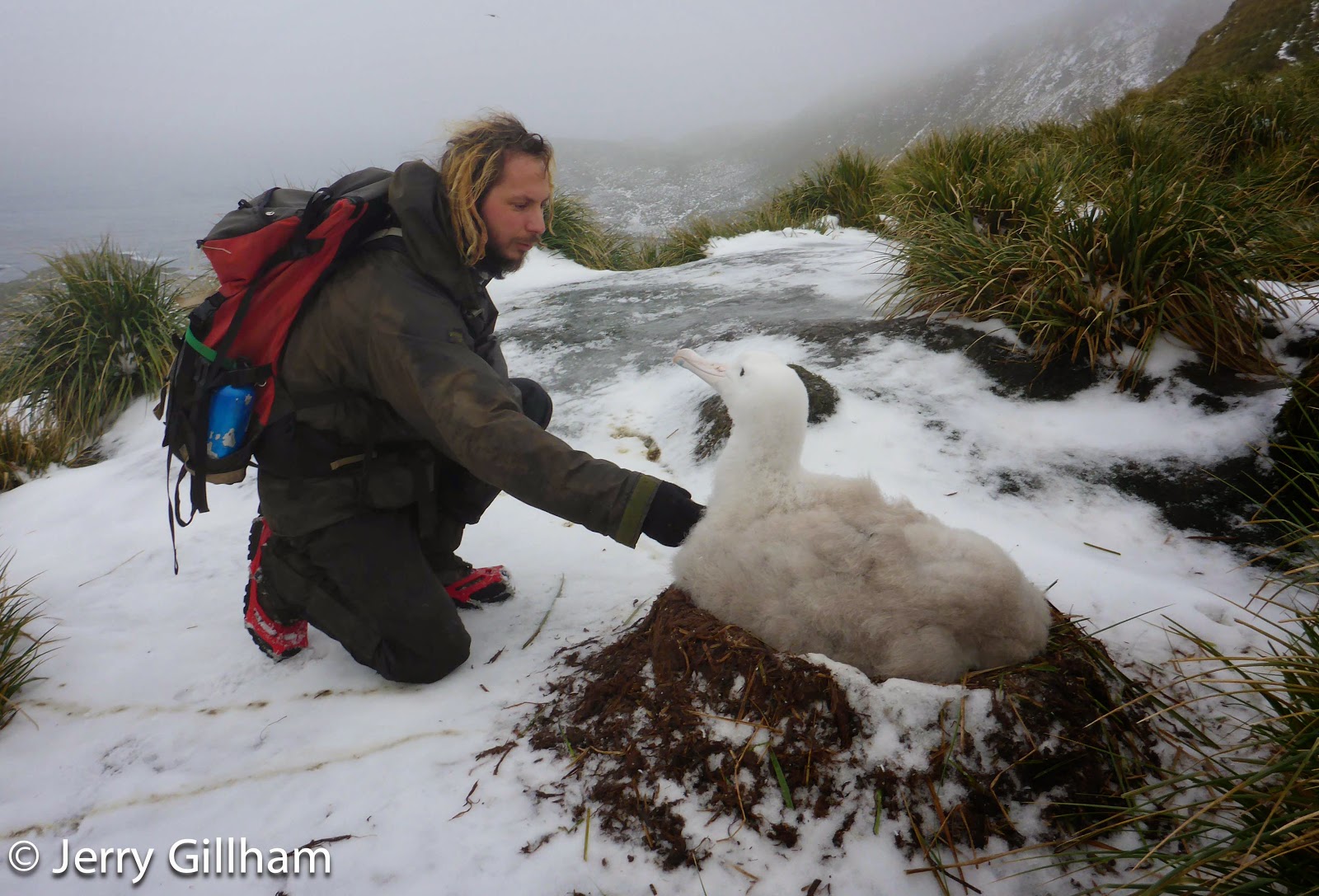
Greeting a friendly Wandering Albatross chick. We go past this one every time we walk up the hill and it has got quite used to me sitting beside it and chatting. It is yet to respond though, which I find a bit rude. Jess's photo.

The final part of a great day was a slow walk back along the beaches. While keeping an eye out for Leopard Seals I was held up by a group of Gentoo Penguins who consistently come out of the water at the gentle, sandy slope at one end of the beach then walk all the way along past the rocks to their congregation areas at the far end. The sharp claws on the end of their feet are good for walking up frozen streams, but not so good for cutting across or going down the thin sheets of ice now stretching across parts of the shore and seeing them regularly slip and slide makes me feel better about my own stability inadequacies.
  
Gentoo Penguins heading home across a frozen stream.