Saturday, 5 December 2015

Signy

16th to 19th November

Unlike the other British Antarctic survey stations, Signy operates for the summer only. Sitting just south of 60 degrees it endures a full Antarctic winter and upon arrival the base staff never quite know what to expect. Six of them got ashore that first day, cutting through the choppy sea on the small RIBs, to check it out, returning to the ship in the evening with tales of snowdrifts and flooded stores.

The following day was calm and sunny, suitable for a larger group of twenty or more of us to get ashore and get working. First up were the important people: the station staff and the technicians looking at getting all the generator, boiler and water systems up and running. Afterwards the manual labour, including me, got our jolly ashore.

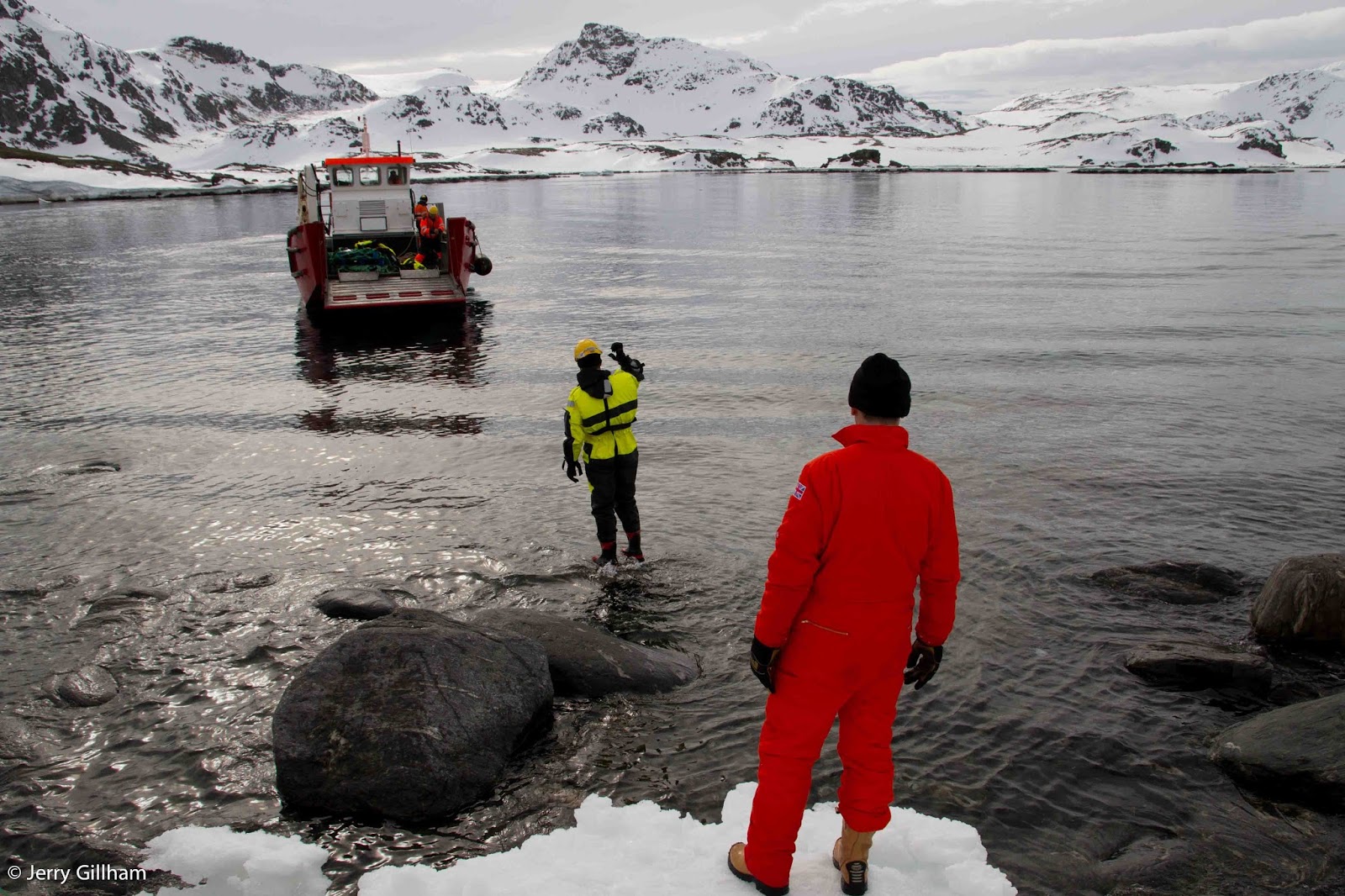
With the bay full of ice the tender couldn't get to the jetty so we were unloading at a point on the shore around 100m from the station. From there the cargo was lifted onto large sledges and towed by skidoo over to wherever it was needed, whether for immediate use and installation or stacked up to be sorted through later.

Station damage over the winter was minimal as everything had been well secured before departure. Much of our work involved digging away at the snow; uncovering buried equipment and clearing it from where it had drifted up against the buildings, opening walkways and reducing the chances of flooding once it starts to melt. This last necessity was exemplified by the state of one of the store rooms. Marks on the doors and walls showed it had flooded to an impressive 30cm at one point, but we were greeted with a solid 10cm of ice on the floor. A team of ice breakers, shovelers and moppers were deployed and had largely cleared it by lunch time. Enough to restart one of the big freezers which happily worked, cooling itself and melting much of the remaining ice in the room.

Perched on the jetty eating chips sent over from the ship, we reflected on how nice a day it was. Piles of clothing littered the site, evidence of shed layers from people expecting the worse now working in single layer thermals and passing round the sun cream. The brilliant white of the ice-packed bay was broken only by lounging elephant seals, while the glaciers, cliffs and peaks all around us were a reminder of what a potentially inhospitable place we were in, despite temporary comforts.

Normally if the weather is good at relief we would work until dusk but we were called back to the ship mid afternoon, leaving the Signy crew to enjoy their first night on station. The reason was the sea ice. That big barrier we'd sailed through had been pushed south by the winds and had crept up on our current location. When we left it before it had taken another hour to get to Signy, a distance of maybe ten miles. This time it was a couple of hundred meters, just the distance back to the ship that was sat right at the edge of the pack, ready to cut off though it to find a larger area of open water suitable for spending the night.


The wind picked up the following day, pushing a barrier of ice across the entrance to the bay and preventing us from getting ashore. It was touch and go after that but we managed to get a tender in and unload the remaining cargo; the fresh and frozen food as well as the all important bond. Once everyone was happy the base was up and running properly, with all systems checked and approved, we were heading back through the ice on our way north.

The first humbers brave the conditions to take station staff ashore for an initial inspection.

Better weather for our visit ashore on the tender, full of food (in the blue boxes) and an array of science, domestic, technical, engineering and personal kit.

The RRS James Clark Ross sitting smartly in the bay.

Shovelling snow. A popular pastime on Antarctic bases.

Transporting goods from the landing site to the station. A long way man-hauling or a short way by skidoo.

Breaking for lunch on the jetty.

Vital early job; attaching the sewage pipe.

More digging.

Directing the tender in to the improvised landing site.

Happy station staff, left for another summer.

Signy station.
Jerry

Monday, 30 November 2015

Enter the Ice

15th and 16th November

We hit the ice on 15th November. There were a few large 'bergs around the previous evening so many of us were up on deck early, excited at the increasing number and variety of sizes and shapes. Huge, flat-topped blocks, smaller amorphous chunks and the most dramatic ones with spires and turrets rising like something from a gothic fairy tale, evidence of where they'd been eroded by the waves and then rolled over. Dotted amongst these were the first bits of land we'd seen in three days. Bleak, dark islands. Just rocks in the ocean, perilously steep and ice-covered with emotive names like Inaccessible Island.

On the horizon what looked at first like a silvery line, possibly a reflection of the distant sun, resolved itself as the edge of the brash sea ice. It was a very definite line, before which there was open ocean carrying ice fragments and after which was compacted ice fragments with the occasional stretch of open water. There was tremendous excitement on deck as we all crowded round either the bow or the top deck viewing platform to enjoy the moment, around 11am, when we heard the first crunch of ice being pushed against ice as we edged our way into this new domain.

Irregularly shaped blocks of ice measuring ten to thirty meters across, standing just fifty centimetres clear of the water, dominated the surface. The gaps where they don't tessellate being filled in with the broken fragments that have been sheared off when they grind against each other. It's the gaps we want to aim for, slipping between the big blocks rather than trying to break them apart. As we got further in the gaps got smaller and the big blocks closer together. Progress slowed and by the afternoon it wasn't unusual for us to be stopping, reversing slightly and altering direction by a few degrees before pushing forward again. In our wake the open water marking the route we'd taken quickly closed up as the ice spread itself out again, possibly in smaller fragments carrying a little red paint.

An unanticipated but pleasing aspect to being in the ice is how smooth the journey feels. Gone are the nausea-inducing rolling seas, replaced by a smooth, slow glide interrupted by jolts that rock the ship like airplane turbulence. We made a maximum three knots through this, compared to the twelve we can do in open water.

The last hour in open water gave us our first views of whales on this trip. Distant spouts of, we think, minkes. Leaping clear alongside the ship, travelling in small groups were a few penguins; gentoos, chinstraps and, once we got into the ice, adelies. We saw more of them standing in small groups on the larger bergs or moving through the ice field like trains of ants crossing a particularly broken up patio. Dotted around too were crabeater seals, sleeping peacefully or putting their heads up to see this big red monster carving through their domain.

Twenty four hours later we broke free, back into open water. The way the ice has these very definite boundaries, controlled by wind and ocean currents, seems bizarre. There's no gradual change, it's an instant jump from one world to another.


The cloud-covered peaks of Coronation Island had been visible for some time but as we drew closer to Signy, our first port of call, the mountains seemed to get bigger as the cloud got heavier. Eventually we pulled up within reach of our destination, surrounded by spectacular steep slopes and glaciers plunging into the sea.

One of the first really spectacular icebergs.

A line of white on the horizon slowly resolving itself into the edge of the ice.

Eerie towers rising through the broken surface.

Pushing its way slowly through the ice, the RRS James Clark Ross.

Crabeater Seal.

Adelie penguins, pushing themselves along on their bellies.

Snow, reducing the visibility until it was nearly complete white.

Meanwhile... inside the ship.

While the cracks are useful for us to push our way through on the ship for some of the residents they provide more of an obstacle to a smooth journey.

The mountains of the South Orkneys near Signy. Spot the crabeater seal on the nearest ice.

Some of the 'bergs were large enough to have little lumps and valleys to hide in.

Looking over the pointy end of the ship to where it was breaking through the ice.

Adelie penguins, up to no good.

Love those little white rings around the eyes.

Snow petrels accompanied us the whole time we were in the ice, whizzing round and round the ship, looking for marine crustaceans near the surface where we'd disturbed it.

At times it looked like you could have got out and walked across the ice. I think if we were here at the end of autumn, rather than spring, I'd have been concerned (and secretly excited) at the prospect of getting stuck.

Amazing colours of the icebergs (mostly white and blue).

This is a long exposure photo of us edging through the pack at night. When traveling through the ice at night these two huge spotlights move around as the skipper picks out the smoothest route. This is a long exposure photo of us edging 

Nearer the edge of the pack the gaps between ice get bigger and the channels open up.

Groups of chinstrap penguins accompanied the ship heading through the narrow channels of open water.

One cheeky adelie hanging out with the chinstrap penguins.

Absolute mirror-calm seas gave the place a somewhat spooky air. I spent a long time thinking about Scott, Shackleton and the others, but also people like James Cook and James Clark Ross himself, after whom our ship is named. They were amongst the first people to sail these seas, back when whatever was over the horizon was truly unknown.

It's difficult to get into pictures just how it feels to be in this environment, with ice as far as you can see, Even in a big, modern comfy ship you feel a sense of vulnerability. Like, if the weather turned against you there is nothing you could do to prevent it.

Jerry

Saturday, 28 November 2015

The Falkland Islands


7th to 12th November

Having been through the Falklands before I was keen to explore some new parts, specifically some of the hills to the west of Stanley. Saturday was clear and sunny so the ship's doctor and I headed that way, through the town and all the way to the end of the inlet upon which the harbour and town is based. That in itself took about an hour and a half. Striking off across the moorland which makes up the majority of the island terrain we headed in a fairly straight line for the top of Mount Tumbledown. The exposed rock, reaching out of the grass at the top, belies a series of ridges running across the northern part of east Falkland. 

Views from the top of Mt Tumbledown.

Scrambling though this we got spectacular views back down to the ship and west across the rest of the island. As we sat and ate our lunch we were approached by a confident turkey vulture watching us with interest.

Turkey vulture in the foreground, cloud rolling over Stanley in the background.

Further along we came to a memorial to those killed on the mountain in the 1982 war. While we were enjoying scrambling round in shorts and t-shirt on a sunny day, with minimal kit and provisions, it was difficult to imagine it any different. Yet it was impossible not to try and imagine being up there cold and wet, sleep-deprived, desperate and under fire. Whatever your thoughts on the conflict itself, the horrors those on Mt Tumbledown and the surrounding peaks endured is quite a thing and should not be forgotten.

The memorial cross on Mt Tumbledown.

As we arrived back at the ship a few hours later we met the rest of the station staff and marine scientists who had travelled down on the long, long flight via Chile. Understandably everyone was in need of a good shower and long sleep, but that didn't prevent us exploring and enjoying the rest of our time around Stanley.

I managed to paddle in the sea at surf bay and two trips round to gypsy cove, seeing a total of five Magellanic penguins and a few Peale's dolphins as well as the smaller Falkland songbirds. One of those trips was called short due to heavy rain while the second needed a quick March to get back to the ship just two minutes before shore leave was cancelled. 

An informative sign at Surf Bay.

I managed more paddling in the sea at berthas beach while the ship was refueling. Commerson’s dolphins were surfing back and forth along breaking waves, their little black and white bodies showing up in the clear blue waters.

Dramatic clouds over Bertha's Beach.

Further along the beach a small colony of Gentoo penguins walked up the sandy beach and through a grassy field, dodging sheep to get to their nests. The combination of penguins and sheep is an amusing and confusing sight.

Gentoo penguins amongst the sheep.

Before our proper departure we had to return once again to Stanley to pick up a replacement crew member, covering for illness, before we could properly set off south on Thursday evening.

Off to sea!

Waving goodbye to Stanley and the Falkland Islands,


Jerry

Traveling South

4th to 6th November

We're on our way south. Three years ago, when first starting with the British Antarctic survey, it was only once I was actually on the ship and leaving the Falkland Islands that I felt it was really going to happen. Until that point it all felt a bit like a dream or a mistake. This time it's equally exciting though feels a lot more familiar, like returning home.

Our epic journey started on Wednesday with an immediate hold-up. Severe weather in the Falklands meant our flight got delayed by nine hours so we were put up in the basic hotel at Brize Norton for the night, rising by five the next morning for an early check in. I'd travelled down from Cambridge with another ten, mostly bound for the science cruise that the ship will undertake around dropping summer staff on the islands (or we'll get dropped off around the science cruise, relative importance of each depends on who you are talking to). Between us we had a huge amount of extra luggage; massive bags and boxes full of personal gear and science equipment that hadn't been ready to put on board when the ship left the UK in September. With all the extras I'd accepted I checked in my own body weight in luggage.

The journey down to the Falkland Islands is two nine-hour flights with a short stop off at Ascension Island to refuel. This is the first time I've been through Ascension when it's not been dark or foggy and even though we were not allowed to leave the departure area, 'the cage', I could enjoy the strange views over the bleak lowlands and artificial cloud forest higher up.

The view from the cage out at Ascension Island.

It was midnight by the time we arrived in the Falklands and three by the time we'd retrieved our mountain of luggage, loaded it onto the minibus and got to our B&Bs in Stanley. That night in a comfy bed was luxury.


The next day we moved onto the ship, the RRS James Clark Ross. With a crew change as well as us arriving it was a hive of activity. Luckily I had no duties so wandered into town to enjoy an ice cream in the sun.

A military band playing under the whalebone arch in Stanley.


Jerry

Tuesday, 3 November 2015

See you in spring

Last minute things: check I've got my passport. Check I've got my travel documents. Check I've got my... ah, I'm sure it'll be fine. The main job now is to pack it all into a couple of bags and fill any remaining space and luggage allowance with luxuries (not necessarily those defined as such by UK tax).

I've done some saying goodbye to people, but others get missed as proposed last-minute get-togethers fall through, so a 'bye' email or text will have to do.

My final few bits of training and meetings have been carried out these last few days at work and I'm pretty confident I've done everything on my list (though I have lost the list so can't be 100%). The last few weeks at BAS HQ have been a little strange as the building gets less and less busy with people departing southwards. The most frequently asked question around the canteen is 'when are you off?' as people get impatient, seeing photos and updates from friends already down there.

The next few days will see me get a minibus from Cambridge to Brize Norton, plane via Ascension down to the Falklands, then join the ship, the RRS James Clark Ross. My previous experience on the JCR is a happy one with minimal sea-sickness. However other travels have indicated that this may have been a fluke, so I'll be taking myself a sea survival kit; scopoderm patches, bottle of water, packet of biscuits, plenty to read, watch and listen to. Fingers crossed I'll be able to get out on deck, looking out for albatrosses and whales, but I'll be prepared for spending a lot of time lying in my bunk.

On previous trips down I've been straight in to Bird Island, a three day crossing, but this time I'm excited to be going via Signy, the British Antarctic Survey's station on the South Orkney Islands. It'll be as far south as I've been and I'm hoping to see loads of ice and some new penguins. The base there is summer-only so we'll hang around while they get it all up and running again, which will hopefully give us some time to experience the area a little.

Then it'll be up to Bird Island, maybe calling in at King Edward Point, South Georgia on the way to say hello to a few friends.

I've been spending the last weeks before departing doing all the stuff I won't be able to over the austral summer; running and mountain biking in the hills (https://vimeo.com/143548558), getting my culture on (galleries, gigs, plays) and eating fresh fruit and veg.

Jerry

Friday, 25 September 2015

Back at BAS

I started back at the British Antarctic Survey a month ago in my new role as Station Leader for Bird Island. Life has been pretty hectic since then as the other new SLs and I have found our days full of training courses, document reading and planning for the upcoming season. A whole range of topics have been covered from people-managing skills to the computing systems to managing major incidents. The latter has tested our responses to some pretty daunting scenarios; buildings on fire, planes falling out the sky and major oil slicks. While slightly terrifying they’ve also been extremely valuable in increasing understanding and confidence in what we can do to mitigate problems, how to deal with them and how to manage the station and personnel through the good times and hard times.

Three years ago I arrived at the pre-deployment training week at Girton College with little idea of what to expect and spent my time trying to absorb as much information as possible, trying to work out how much was relevant for my job and my destination. This year I turned up as the go-to guy for questions on Bird Island, feeling much more confident in my role due to experience down south and the training in Cambridge. I tagged along to most of the lectures and discussion groups as there’s so much I still don’t know, especially about life on the bases further south, and I was also able to pick out a few of the most relevant points and reiterate them to my team.

Oil spill response and fire safety were followed by the first aid training. I’m up to date with this so popped back into the office for a few more bits of paperwork before heading back to watch the riotous scenarios the teams are expected to deal with, complete with very enthusiastic acting by the victims. As in my first year the great thing about having everyone together is that you get to meet people from so many different backgrounds, with a large range of jobs, all excited about heading to Antarctica.

The official pre-deployment staff photo 2015

At the end of the week everyone departed and I accompanied the folk who will be heading south for the whole year as they went up to Derbyshire for winter teams training week. I last did this in the year termed ‘rainageddon’, such was the apocalyptic level of mud generated. It now takes place in an outdoor centre that is a pretty good representation of a station in that it requires everyone to pitch in cooking, eating and cleaning together.

Pitching a tent. In the rain.

True to form we did get a bit of drizzle but were able to get a bit of shelter to talk about navigation, campcraft, search techniques and basic ropework. 

Replicating blizzard visibility with the bucket-on-head technique. The aim was to find the second bucket.
Making a pulley from simple climbing kit.
Testing the effectiveness of the above pulley.
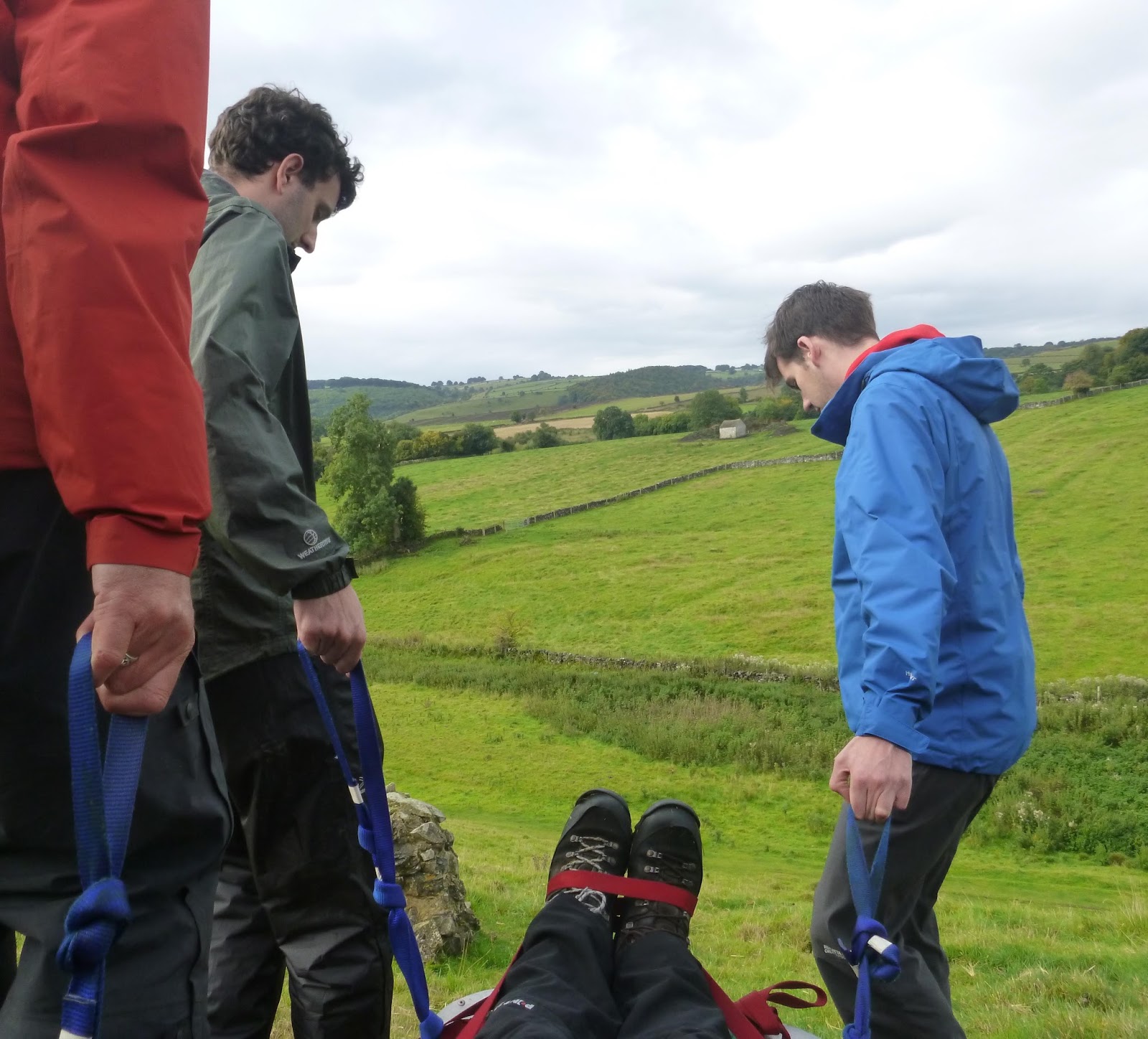
There’s only so much that can be taught indoors though so we managed to get people out to navigate around the campsite and the moors above Curbar Edge before testing their skills on the high ropes course. As has happened a few times recently I played the casualty in a rescue exercise, this one involved me being lowered down and then hauled back up a steep slope on a stretcher.

Putting together a stretcher and anchor system.
The view from the stretcher as we headed off down the slope.
With the sun out we headed up to the moors above Curbar Edge for more navigation practice.
Lunch break.
Learning rope ascending techniques with a couple of jumars on the high ropes course.
Taking advantage of the high ropes course.
Just hanging about.
All roped up for ascending and descending.
Bare feet or wellies... a test of optimal climbing footwear.
Following the excitement of all these group bonding exercises it’s kind of down to earth with a bump as everyone goes their separate ways and I head back to the office for more courses. I can’t wait to head off south again in a little over a month, but still feel I’ve a lot of preparation work to cram in before then.

Relaxing on one of the climbing walls.
The hugely enjoyable end-of-course barbecue.

Friday, 28 August 2015

How to get a job in conservation.

I have worked in conservation for about ten years now and have often been asked about the best ways to get a job in the field. 

This blog is an attempt to answer some familiar questions and provide some guidance for others wishing to pursue a career in this sector, based on my personal experiences and from chatting to colleagues. It is by no means the be all and end all of ‘getting a job in conservation’ and no doubt you will get different advice from many other sources. I will try to respond to any questions and welcome comments from anyone wishing to contribute their own advice.


What do you want to do?

It is important to say that ‘working in conservation’ can cover a large range of career opportunities, and many colleagues I know have switched from one to another. Here are just a few:

Academia – carrying out novel research to promote our understanding of a species or system in order to more effectively preserve them. Usually associated with a university and PhD work.

Research assistant – often the person that does the fieldwork for the above academic. Involves more time getting dirty in the field, close to the species or ecosystem being studied. Less involved in the writing up and will frequently be on a short contract. Often requires a postdoc or significant experience.

Estate worker – carries out important manual work on reserves. Could be anything like path maintenance, reed-bed transplanting, pond creation, woodland management. A good, practical, muddy job with the rewarding aspect that you can often see your work directly benefiting wildlife.

Wardening – will generally involve a huge range of duties from dealing with the public and special interest groups, to manual work on your reserve, to wildlife monitoring. Many reserves have seasonal wardens to coincide with peak times for visitors and wildlife.

Public relations – could involve promoting a particular reserve or company, or focus on public interactions such as educational activities with school groups.

Policy - You want to make a real difference? Get into policy. The thankless task of assessing all the science and then presenting a plan to someone who doesn't understand or has a different agenda. I have nothing but respect for the activists and policy-formers trying to influence change on large scale.


My conservation career

Here is a brief review of the path I took to get to where I am now:
I have always had an interest in wildlife and the outdoors and was sure I wanted a job relating to that but didn’t know quite what. After school I took biology, chemistry and geography A-levels and then studied straight biology at university, with mediocre success. Following a research masters in science of the environment I was ready to move out of academia and into the real world.
After what felt like a long time volunteering I got my first conservation job as a seasonal warden on the Farne Islands, Northumberland and fell in love with islands and seabirds there. After a few years I continued the wardening work down in south Wales, to Skomer and then Skokholm islands, being responsible for overall running of the latter. In 2012 I got a dream job with the British Antarctic Survey to work as a zoological field assistant, collecting data on penguins and petrels on Bird Island, South Georgia.


Qualifications

Take a look at environmental recruitment websites such as countryside jobs service, environment jobs or stopdodo and you will see many asking for a degree in a relevant subject; ecology, environmental management, conservation science or such like. I studied straight biology as I was unsure of the career I wanted and thought (probably rightly) that a mainstream science would offer plenty of alternatives at a later date.
Prior to entering university I would say biology is an essential A-level subject and that one or both of chemistry and maths in support would be highly advantageous.

If university is not for you that shouldn't rule out any but the jobs in academia. There are many institutions offering courses in land management that will often give you a variety of practical skills to go alongside the theory.

Having said this, I have worked with people who have arrived in conservation from many different backgrounds: art school, accountancy and bus driving are three that spring to mind, and that leads me to my next point...


Volunteering - the most important thing!

It is an unfortunate fact that it is very difficult to get a job in conservation without some volunteering experience. I say unfortunate as this can be a disadvantage to those who are perhaps limited by location or finances, however for others it can somewhat level the playing field and filter the great from the mediocre.

Regular volunteering has huge benefits:
  • Increase your knowledge. Spending time with experts on birds, mammals, plants, insects etc. will enhance your ID skills and knowledge. There are a lot of people graduating from university with a degree in ecology or conservation science whose knowledge of British species is surprisingly poor. Spending a bit of time with an expert will really make you stand out from the crowd.
  • Learn new skills. As well as ID skills you may get the chance to learn new practical tasks as some organisations will put their most valued volunteers through courses; first aid, brushcutter use, bat identification. There are other skills you can learn just from hanging around with the right people and groups – bird ringing, vegetation classification. Any of these will make you more employable.
  • Deciding what you want to do. As stated above there are many aspects to working in conservation. If possible spend some time shadowing a few different people on a local reserve. You might find you most enjoy the practical aspect of woodland management or get a real kick out of taking school groups round.
  • Shows dedication. This is where it levels the playing field. While the rich kids are off playing at saving orangutans in Borneo you may be getting covered in mud and rain, moving large chunks of reed-bed from one boggy field to another. But believe me, when employers are looking through CVs, wondering who will work well in their team it is the latter that stands out.
  • Making contacts. As in every single area of employment there is an element of who you know. Working in the seabird & UK islands scene it is rare that I meet someone in the same sphere of employment who I either haven't heard of or don't have friends in common.

I was relatively lucky in that I went through university with the first round of tuition fees, which seem fairly modest now. Although I have since accrued more interest on my student loan than I have paid it back (no one goes into conservation for the money) it was not the financially crippling burden it could be today. I would heartily recommend a few months volunteering in different areas to decide which aspect, if any, of conservation is for you before committing to it as a career.


Who can you volunteer with?

The vast majority of conservation bodies are charities who rely on volunteers to carry out their essential work. The best thing is to get in touch with your local reserve and ask about work parties they run. Purely a personal thing but I always found the Wildlife Trusts most grateful for volunteers and most likely to help develop your skills and employment potential, the RSPB pay their employees a laughably small amount but will often put long term volunteers through extremely useful training courses. The National Trust and John Muir Trust run a variety of work parties in some extremely exciting places.

Volunteering opportunities broadly fit into four categories:
  1. Local, ongoing work. Regular, seasonal maintenance work at a local reserve. I volunteered like this a lot while studying for my masters and while working part time. I would join the local Wildlife Trust group for one or two days a week for whatever maintenance or management tasks were required on the local reserves.
  2. A week away. A longer stint, usually with a group where accommodation and sometimes food will generally be provided. A charge may be asked for to cover housing and travel but bursaries are sometimes available for students and unemployed. When I worked on Skomer we asked for a small amount to cover maintenance and improvements of the volunteer accommodation. Groups of up to six would assist with visitor management, wildlife recording, footpath or building repairs. Whatever was needed that week or whatever relevant skills they possessed.
  3. Long term volunteering. On Skokholm I was assisted by two long term volunteers who would be present for two or three months, learning and taking part in all aspects of wardening and island life. As well as these experiences we provided accommodation and would put them through a first aid course. There were some very competent people who passed through that programme and I am pleased to say have gone on to have a variety of interesting jobs in conservation. Both the RSPB and National Trust run similar programmes aimed at developing the next generation of reserve wardens. Competition for these places can be fierce so previous volunteering experience, knowledge and personal connections can be important.
  4. The high-cost, exotic location. There are some good volunteer programmes abroad; I did one in the Seychelles for a few months, recording hawksbill turtle breeding success. For that I think they paid half my flights and provided basic accommodation. However, many of them charge a lot of money and I would try and contact someone else who has volunteered with them to find out what they got out of it. Did they genuinely get some important skills and experiences or did they just have a fun holiday while the company only wanted them for their money?
Many of these are now advertised as full jobs would be on sites such as countryside jobs service.


It can be tough...

Conservation is a growing interest as people recognise the value of the natural world, however that interest is not necessarily shared by government, particularly this current one, who will always cut environmental funding rather than investing in it. Hence conservation bodies are squeezed further and further, many operating on a skeleton staff. Jobs, certainly the ones I have been doing, tend to be short-contract, heavily contested and low paid (although I have done ok as usually I have had my accommodation provided).


But it's worth it.

That first job is difficult to get but keep volunteering, keep expanding your knowledge, skills and contacts and it will come. Once you get your first job it becomes so much easier and all sorts of options open up. I'm of the opinion that you never appreciate nature so much as when you really spend time amongst it, and that is equally true of a huge penguin colony as the small woodland at the end of your road. Working in any size reserve you find all sorts of life you never realised was there, get to see it change through the seasons and take pride when something you've done improves conditions.

And who knows what amazing sights, species and places you'll end up seeing.