Sunday, 20 July 2014

Giant Petrels

The giant petrels, commonly known as 'geeps', are one of my key study species. They're split into two species – the Northern and Southern, differentiated by the colour of their bill tip. Red for Northern and green for Southern. The sexes are basically the same, with the males being marginally bulkier and with longer beaks.
Northern Giant Petrel. Check out that lovely eye and the impressive beak - the salt gland on top to enable filtration of sea water and the huge pointed tip for ripping through carcasses.
The geeps get a bit of a raw deal. The only time you'll see them in any sort of nature documentary is when they're scavenging dead seals or waiting patiently for defenceless young pups and penguins. They'll be fighting with each other for rights to the kill, then shoving their heads right inside these big dead seals, pulling out covered in blood.

No waste on Bird Island. A recently deceased Fur Seal will quickly be reduced to a pile of bones and the geeps are the first ones in there.
They're not as eye-catching as the penguins or as elegant as the albatrosses, but once you start spending some time with them you get captivated by their charisma.

Describing them is a bit like describing a Frankingstein. They're the largest of the procelleria family of petrels and prions. Normally when you think of these birds you'd think of petite Storm Petrels or the elegant shearwaters soaring over the waves, perfectly adapted for a life at sea but a little ungainly on land. Unlike the smaller members of the family the geeps have strong legs that enable them to stalk the beach like dinosaurs. When they fight over food their tails are up, like turkeys, and their wings outstretched as they run at each other, shrieking like banshees.

A beach-master pose as this geep challenges anyone else to try taking his food away from him.
Like most wildlife, it's when you see them with their partners and young that you really warm to them. Giant Petrels are monogamous with long-term pair bonds and often nest in the same place, frequently the same area they were born, year after year. Many of them hang around, with their partners, through the winter.

A pair circling and calling together.
They're amongst the earliest nesters on Bird Island as the Northerns start laying eggs in mid-September with the Southerns about a month later. The nest can be a simple scrape on the ground but is usually a turret built from mud, moss and tussac grass. An ambitious pair may try to use an old Wandering Albatross nest.

The pair will take turns sitting on the egg for around a week at a time while their partner is off feeding. The egg takes about two months to incubate and during this time the birds have to put up with whatever the weather throws at them – wind, rain and snow. There's no ground-based predators here, no rats or cats or mice (which is one of the reasons Bird Island is so important), so there's little threat to the geeps from other life. With a bill like that they're not worth messing with, although there's the occasional territorial squabble between adults.

Geep scrap. These two males were fighting over a nest. The female sat by passively and then left with the loser. Like with most animals the fights are mainly posturing, establishing who is bigger, but then can lead to the interlocking of beaks and with those very sharp tips it's not unlikely that some blood will be spilt. This usually seems to signal the end of the fight.
Each of the approximately 500 nests in my study area gets a number and I'll take a GPS reference so I can plot them on a map later. The majority of the birds here carry rings and darvics. I'll take the numbers down and enter them onto an existing database, from that we'll know whether each individual has stuck with the same partner, changed location, been seen before and many other things. Throughout the season I'll visit about once a week to check on the progress of the egg and chick, ultimately recording whether the pair have bred successfully or not.

Writing down nest number, location and ring numbers of a particularly unconcerned pair. (Hannah's photo).
This is all part of an ongoing, long-term study collecting data on these species to find out all sorts of things like population and population changes, breeding success and survival rates.

Giant Petrels are scavengers as well as predators and can often be seen following boats in the south seas, waiting for any scraps.
Amongst the Southern geep population there's the occasional all-white individual. It's not an albino, it's just a morphological difference. They interbreed with the more usual coloured birds. There's two females like this in my study population of approximately 300 Southern Giant Petrels.

A white morph chick, pretty much full grown and ready for departure.
Two months after being laid a little white chick pokes its way out the egg with this big clunking beak. It's parents stay with it, continuing their regular change-overs for another few weeks, after which time it is left alone. Like most birds of it's kind it defends itself with a snapping bill and the threat of regurgitation – viscous vomit that could ruin an assailant's plumage, fur or jacket.

A week-old geep chick getting it's first rays of sunshine, yawning or calling for food.
As they get older the young birds lose their downy fluff and grow a layer of sleek, black adult feathers. They start to wander away from the nest, but not too far as you never know when a parent will return with food.

Half way through chick development, when they've grown to a decent size but are still covered with down, keeping them warm as the adult feathers develop beneath.
By March the Northern chicks are three to four months old. I'll head round the study area and take weight and bill-length measurements from all of them, also giving them a unique ring so they can be identified in the future. All that remains then is for them to lose their remaining chick feathers, stretch out their wings and head off to sea. By mid-April they'll all be gone with the Southern geeps about a month behind them.

Ready to go. This was the first egg laid last season, in mid-September. By mid-March she was looking beautifully slick and smart and was soon to depart.
They're long-lived birds. I've not seen any figures for ages but there's ones here breeding that are older than me and it wouldn't surprise me if they can get to double that age. Many of these chicks will return to the same areas of their birth to breed, but it'll be a few years before that happens. I was finding apparent first-time breeders this season that were ringed here as chicks in 2005 and 2006. Ongoing experiments using tiny geolocator devices are trying to work out where the young birds go during their teenage years. Ringing recoveries have shown that within a few months of leaving these young birds can be found as far away as Australia. Similar such work has shown a difference in feeding strategies, with females more likely to feed out at sea while males patrol the beaches. As with all good science, the answers are sure to throw up many more questions.

Southern Giant Petrel. Their presence on the island during the winter is one of the highlights of going for a walk.

Tuesday, 1 July 2014

Midwinter part 2

The second half of midwinter week has been full of games, fun and relaxation.

The blood-red sky one morning over base and La Roche.

 With a week off and a big snow drift in front of base what was the most obvious thing to do? Cian and Jess were half way through building a snowman, or snowmaiden, when I went out to help them. She was meant to be a female companion for Jess, although Cian seemed to be making early moves on her. I was shovelling more snow for them when I realised it was coming out in large, compact blocks... would it be possible to build an igloo?

Cian and his Ice Bride

 Starting out with low expectations, I was half way through before putting some real thought and effort into it, hence the with problems with the final result. I managed to get a roof on it but it was very cramped – every time I moved I risked dropping more snow on myself. The other problem was the low entrance that meant crawling in dragged in more snow.

The interior roof of my igloo - pretty and more secure than it looks.

Despite these problems I decided to try and sleep there that night. I stayed up late reading indoors and taking photos in the dark until feeling tired enough I crawled in, trying not to drop snow into my sleeping bag.

Sitting outside my igloo, waiting for bedtime. A carefree sleep wasn't helped by the presence of the weeping angel just outside.

Lying there I was comfortable (so long as I didn't move) and warm enough but the problem was I just wasn't tired. It took over an hour of listening to the sea, the occasional distant seal and the worryingly close scavenging sheathbills but I did eventually drift off. All too soon after that I rolled over and woke up with a face-full of snow. By this point I needed to get up and do a wee. After the rigmarole of getting out my bag and crawling through the icy entrance I was once again wide awake. I'm afraid the temptation of going indoors for a hot drink and a comfy duvet was too much and I slept the rest of the night in my own bed.

The illuminated igloo.

One of the big traditions of Bird Island midwinter is the highland games. All suitably dressed we gathered outside where Cian and I had set up a few events; caber tossing, welly wanging, throwing the ball in the snow-hole, triple jump, obstacle frisbee and the free-for-all that was the potato and spoon slalom.

Rob holding his caber.

Cian having a good toss.

Jess giving a welly a good wanging.

We finished off the Highland Games with a ceremonial smashing of the snow-maiden and the igloo.

We rounded off the week with a long day out exploring. Over the hill to Johnson Beach then around to Burton Cove to investigate the cave there. Some of these are spots we can't go in the summer, either because of too much work or because the density of Fur Seals puts the shore out of bounds. Although there are seals about at the moment they are easily bypassed.

Johnson Beach, once pristine white snow, now a Jackson Pollock mess in a limited colour scheme depending on what the Gentoos have been eating.

The big but not deep cave at Burton Cove.

Before returning to base we did a quick check on one of the Wandering Albatross areas, making sure the chicks are doing okay. They are really big and fluffy at the moment, as they need to be what with sitting here all through the winter. Happily they have survived their most vulnerable stage – when they are first left alone by the parents – and through these months there are very few failures.

Wandering Albatross chick in front of Tonk and the cloud rolling in.

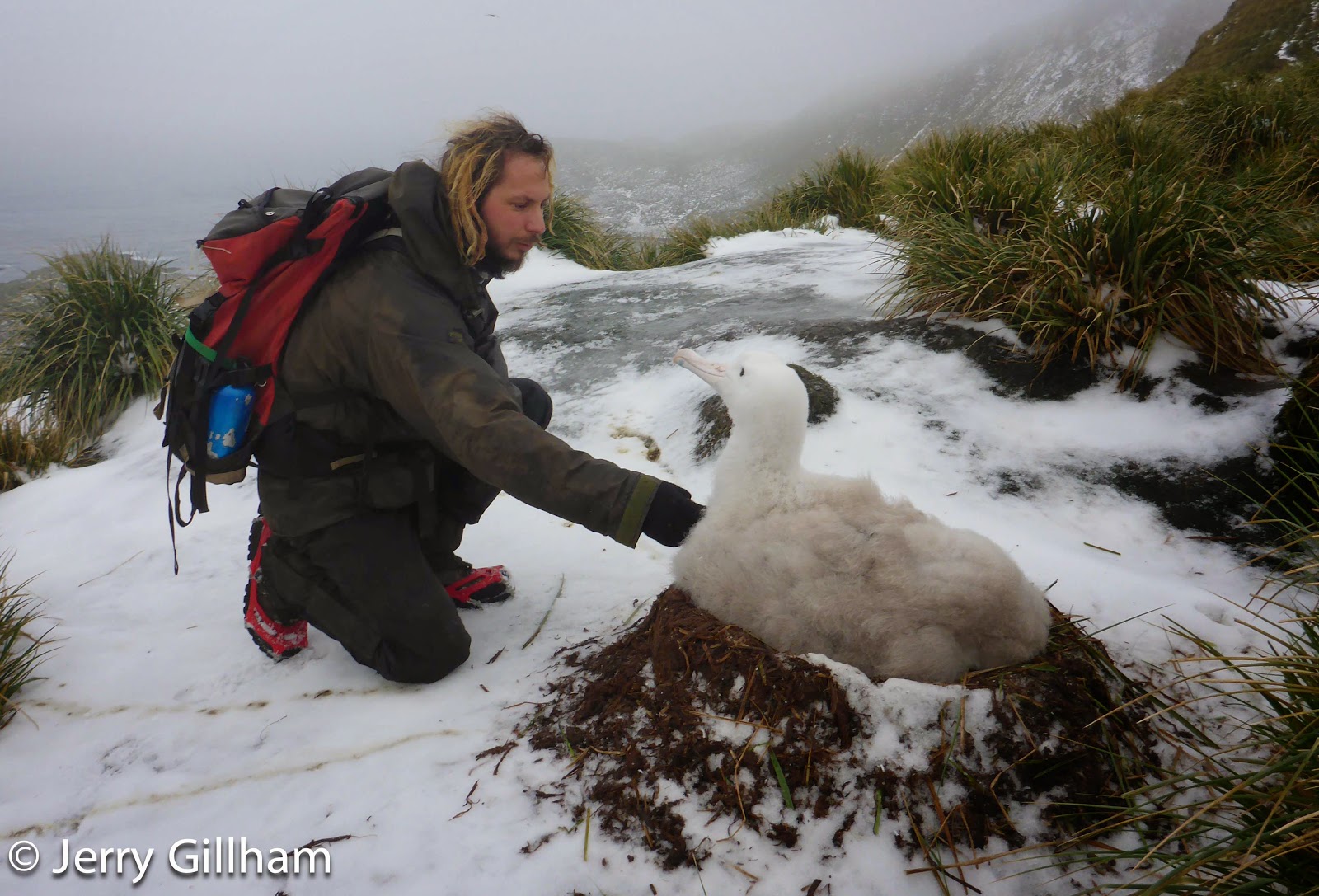
Greeting a friendly Wandering Albatross chick. We go past this one every time we walk up the hill and it has got quite used to me sitting beside it and chatting. It is yet to respond though, which I find a bit rude. Jess's photo.

The final part of a great day was a slow walk back along the beaches. While keeping an eye out for Leopard Seals I was held up by a group of Gentoo Penguins who consistently come out of the water at the gentle, sandy slope at one end of the beach then walk all the way along past the rocks to their congregation areas at the far end. The sharp claws on the end of their feet are good for walking up frozen streams, but not so good for cutting across or going down the thin sheets of ice now stretching across parts of the shore and seeing them regularly slip and slide makes me feel better about my own stability inadequacies.
  
Gentoo Penguins heading home across a frozen stream.


Tuesday, 24 June 2014

Midwinter part 1

The past weekend saw us through midwinter, the biggest celebration in Antarctica. For the bases further south than us it marks the middle of the long months of darkness and they can start looking forward to the return of the sun. For those of us in sub-Antarctica it means the days will start getting longer - it will begin getting light before 11 and we'll be able to stay out after 6.


Dressing up for the photos we sent out to the other bases. These go out, not only to the other 40 BAS over-winter staff but to all the other bases on the continent and sub-Antarctic islands.

The day started with me, as winter base commander, making breakfast for the others. A big fry-up is a rarity but it was worth using up some of our limited supply of eggs and mushrooms along with the almost limitless beans and sausages. I didn't go as far as serving them in bed as no one wanted their room smelling of burnt bacon.

A healthy start to a long day of excess (the glass of orange juice is the healthy bit).

Despite it being a holiday there's some jobs that just needed doing. Rob had his checks or the generators and boilers to ensure the base is still running smoothly while Cian had the daily round in search of Leopard Seals. I headed out to help him with that while Rob and Jess made a start with the preparations for dinner. I say made a start but for a few days previously Jess had been making cakes and enough meringue to build an igloo out of.

Midwinter cake cooked by Jess. The Leopard Seal decoration was by Cian.

Warming up we settled down to watch the The Thing. A chance to compare my facial hair to that of Kurt Russell and, predictably, be disappointed at the lack of similarity between us.

At the start of winter we'd drawn names, like a secret santa, to see who would be making gifts for who. This is a tradition that goes back to Scott and Shackleton's times, when they had to improvise with what resources and tools they had available. Our materials may be less limited but the creativity is still there and the results are always amazing. The amount of effort that goes in is incredible as people find skills they never knew they had.

Proudly displaying our gifts.

The clock that Jess made me using retrieved bird rings and seal tags, with an illustrated history of each one.

The model I made her of a Wandering Albatross family.

Following a long, drawn-out dinner we collapsed into the comfy chairs and listened to the midwinter broadcast put together by BAS and the BBC. We were delighted to hear greetings from, amongst others, comedians Adam Buxton and Bill Bailey, spaceman Tim Peake and explorer Ranulph Fiennes.

Sitting down for an excellent dinner.

Games, snacks and drinks took us into the small hours.

The next day was supposed to be one of nothing but relaxation, slobbing out in front of a few movies. Yet the presence of two leopards and one Weddell Seal meant we were running around excitedly outside for far more of it than planned.

Weddell Seal. One of the few occasions it acknowledged our presence before collapsing back down to sleep.
The week continues to be both fun and relaxing. Coming up we've a few plans for days out and the traditional midwinter games, but yesterday we created a 12 hole crazy golf course around the base which was great fun.

Par 1 across the masking-tape bridge.

A couple of holes down the corridor.

A beautifully decorated generator room course. 

Monday, 26 May 2014

Wandering Albatross

While the onset of winter marks the departure of most of Bird Island's wildlife, there's one iconic resident who stays with us through the cold, dark months.


The Wandering Albatross, Diomedea exulans, are truly amazing birds. They look unreal sometimes, like a huge relic of a prehistoric age as the adults stand well over a meter tall and can weigh more than 10kg. Their wingspan is the largest of any living bird, at up to 3.5 meters. That means they can soar above the oceans for hours at a time without expending any energy flapping, searching for food in the vastness beneath.


They mainly eat cephalopods but will readily take crustaceans, small fish and carrion. We regularly find regurgitated piles of squid beaks beside their nests which can be collected for measuring and identification to enhance our understanding of their diet – small changes may be indicative of greater changes to the marine ecosystem.
Wandering albatross are frequently seen from ships in the Southern Ocean. Described as a 'bird of good omen' by Coleridge, they can follow them for days, often feeding off any scraps thrown overboard. Unfortunately this has been hugely detrimental to their health as they can get caught, tangled up and drowned by the long-line fisheries boats. Advances are being made with deterrents and legislation about operating procedure, particularly around South Georgia where by-catch has been hugely reduced, but it continues to be a problem in less well regulated parts of the ocean.

Copulating pair, an infrequent October sight.
They build a nest out of mud, moss and tussack grass that will be used year after year and stands around 40cm high. These are spread in loose colonies across the island. In mid to late December a single egg, white and 10cm long is laid and incubated by both parents.

Chick on the nest with both parents present.
Between Christmas and New Year the albatross assistants, with as much help as is available, cover the whole island counting and marking each nest with a numbered stake and GPS plot point so we can map them. Where possible we'll record ring numbers of both birds – this often means repeated return visits as each one can be away from the nest for well over a week. There is a ridge behind the base where the birds are studied more intensively; they carry coloured darvic rings so they can be identified with minimum disturbance and at times the area is visited daily to get precise laying and hatching dates.

Checking for eggs. The clipboard is useful not only for making notes but also as a bit of protection. The birds are not particularly aggressive but those beaks are big and sharp.
With this simple long-term monitoring we can build up a life history of the population, looking at changing trends in survival rates, life expectancy and breeding success. With such long-lived birds, over 50 years, it's important to have consistent monitoring techniques so we can draw comparisons over time and with other locations.

While the established pairs are alternating time between egg-sitting and fishing the younger, unpaired birds are searching for partners. Wanderers are monogamous and generally mate for life but there's always single birds trying to impress others. They gather in groups and show off by spreading their wings, throwing their heads back and uttering a variety of gurgles, screams, whistles, grunts and snapping. Later on they may tap their bills together and mutually preen each other. These rituals are repeated by long-term pairs re-establishing their bonds.

Young male (front) spreading his wings and skycalling to impress the female on the right. Behind him another copies his obviously impressive chat-up techniques.
A long-term pair preening each other to re-affirm their partnership.
Incubation takes the best part of three months. Once the egg hatches the adults continue taking turns looking after the chick for another few weeks. By the time it's old enough to be left alone, early April, they've got a deep layer of downy feathers over an inch thick and the ability to vomit oily, plumage-ruining sick on anyone they perceive to be a danger. Despite this defence many Wanderer nest sites have been decimated by introduced land predators such as cats, rats and mice. One of the reasons Bird Island is so important is that it has never hosted these predators and it is hoped that the rat eradication on the South Georgia mainland will re-open historic breeding grounds.

Young chick being preened and cared for by a parent.
Poking a head out from under a leg for a view of the outside world.
As the winter approaches and the island gets covered with snow and ice the chicks sit tight on their nests, islands of warmth amongst the inhospitable cold. During the harshest storms they sit tight, curled up asleep with their heads tucked down. During this time they are visited roughly once a week by each parent, returning with a belly full of rich food that they regurgitate straight into the hungry chicks.

When snow covers the island all that stands out are these small balls of warmth.
Young chick getting a delicious, oily snack.
Throughout the season the nests are visited at the start of every month to check which ones have hatched, how the chicks are progressing and to record any failures. In late August, with the chicks still mostly fluffy but with dark adult feathers showing through, we go out and fit them all with unique identification rings. Before coming south the largest bird I'd ringed was a Greater Black-backed Gull. At the time that seemed pretty big, especially compared to the Willow Warblers and Chiffchaffs I was used to, but although the techniques are pretty similar there's some major differences in how to hold these birds.
Data retrieved from birds with rings, and more recently those carrying tiny geolocators, was told us all sort of information about their range, routes and feeding areas. It helps to know these things when trying to protect them and their key habitats.

Engaging in some friendly chat with a healthy looking chick.
An unconventional approach to ringing. This strange position keeps the chicks passive and safe, allowing a quick squeeze to apply a unique ring.
Around November, after about nine months on the nest, with the weather warming a little in the Antarctic spring the chicks start to fledge. By this time they've lost their down and have a complete covering of dark adult feathers. For a long time they get off the nests and walk around, investigating their surroundings. On windy days they'll hold out their wings, feeling the breeze rushing through their feathers and trying a bit of flapping, building up those flight muscles. This increases the older they get and late in the season you can see these huge birds facing into the strong winds, jumping and flapping, getting 6ft in the air but wobbling in a rather uncontrolled manner as they try to master the balance and timing it takes to move in a straight line. It takes a lot of practice to make flight as easy as the adults manage.

An almost fully developed chick getting a  visit from both parents. It's rare to see both adults together, particularly at this stage in the season when they are both continually heading out and returning with food.
Letting the breeze blow through your wings must be a great feeling. 
Not far off departure, looking for a launch spot.

Once they fledge the young will probably spend at least the next five years at sea before returning to their breeding sites, though they don't usually start mating and laying eggs until they are 10 - 15 years old. During this 'teenage' period they will follow the circumpolar winds and currents, travelling clockwise around the whole Antarctic continent. A successful pair will not breed for another year and instead will return to the ocean where they are most at home, soaring effortlessly over the waves on huge, unflapping wings.