Friday, 8 May 2015

The return journey, part two.

The Shackleton pulled into Stanley on the Falkland Islands and as soon as we were allowed we headed ashore and into town.

Harsh weather on the FIPASS as we arrived. We headed out but got driven back by the wind and rain before reaching the adjacent HMS Clyde.
I'm thankful we weren't dropped anywhere busier as our first taste of civilisation as Jess, Cian and I were a little bemused and cautious; when crossing roads we waited patiently for approaching vehicles however slow and far away they were. Entering the supermarket we were thrown by a cat running in past us and then the vast array of goods on the shelves. I had to remind myself that unlike the Bird Island stores you can't just take something off the shelf, sample it and then walk off with in in a pocket.

Is this normal supermarket goods now? No longer hundreds and thousands but billions and trillions?
That evening us six returning islanders went for a fancy meal, a celebration of being back on dry land. The next evening we joined the ship's crew and rat team in a busy pub. Being in a crowded, loud environment didn't seem as alien as I thought it might. I thought back to first call at the beginning of December when I'd had a mild panic attack after coming into our lounge and finding it full of people. I think the difference was that was after nine months of just four of us in that place.

Soon enough our wintering team had to be split further as Cian remained in Stanley while Jess and I (plus Adam and Mick) headed off to Darwin. Cian's off travelling in South America (volcanoes permitting) and saying goodbye to him wasn't actually as hard as others. I guess we were all tired of emotional farewells and I'm sure we'll see him again in a few months.

Accommodation in Stanley was full so we'd been sent off to the tiny, remote settlement of Darwin. Our initial misgivings were abated when we saw the plush place we would be staying and by the time we'd had a cup of tea and seen a tame steamer duck waddle through the lounge we were completely sold on the place. We've always eaten exceedingly well on Bird Island and the chefs on the ship do an amazing job, but the food at Darwin House was outrageously good. The hospitality of the couple running the place was superb and we spent a thoroughly relaxing couple of days there.

Shags hanging around, making use of the odd shipwreck.
Darwin House, what a setting.
Exploring the surroundings.
As we had no real agenda we spent our time reading in the conservatory and going for short walks, caracaras, red-backed hawks and Commerson's dolphins were all seen within a few hundred meters of the house. Deciding I needed to exercise off some of the food I ran down past Goose Green and onward along the heavily rutted fields that count for roads this far out of the way. I finally reached what is said to be the worlds most southerly suspension bridge (clearly no one has actually checked) across Bodie Creek. The planks across were looking a bit worse for wear and the sign on the gate had worn away enough to make it unclear whether it was safe for vehicles and pedestrians or very unsafe. It was only when getting back and checking that I found it had been closed in 1997 and access was prohibited.

Bodie Creek bridge, worth the run.
Goose Green residents amazed at seeing a person.
Following a long, long flight I arrived back in the UK to be met by my parents as said my last goodbyes to the rest of the team. By the afternoon we were back in the Lake District, out walking in the sun, smelling the lovely gorse, observing the lambs and watching and listening out for small, elusive British wildlife.

Back in the UK.
24 hours later I'd met back up with Jess and we were heading off for our next seabird-related jobs, but that's for another blog post...

Thursday, 7 May 2015

The return journey, part one.

And so the day came when I had to leave Bird Island. In the end it was quick but incredibly hard. One tender-load of incoming goods (fresh veg, technical parts, post) and one going out (waste and recycling, us and our luggage). We waved goodbye to the four new winterers, our last view was of them in a big group hug before teared eyes and heavy fog hid the base from view.

Goodbye Bird Island, look after it for us.
Heartbreaking as it was we had to pull ourselves together quickly to climb up the ladder onto the side of the ship, the RRS Ernest Shackleton.

Up the ladder, knowing that a fall will either land you between ships or on all the waste & recycling.
Onboard we tried to distract our sorrows with a coffee on the bridge, rescuing a disorientated diving petrel and then down to lunch. Specifically the colours, variety and freshness of the salad bar.

Remembering the upsides of the real world.
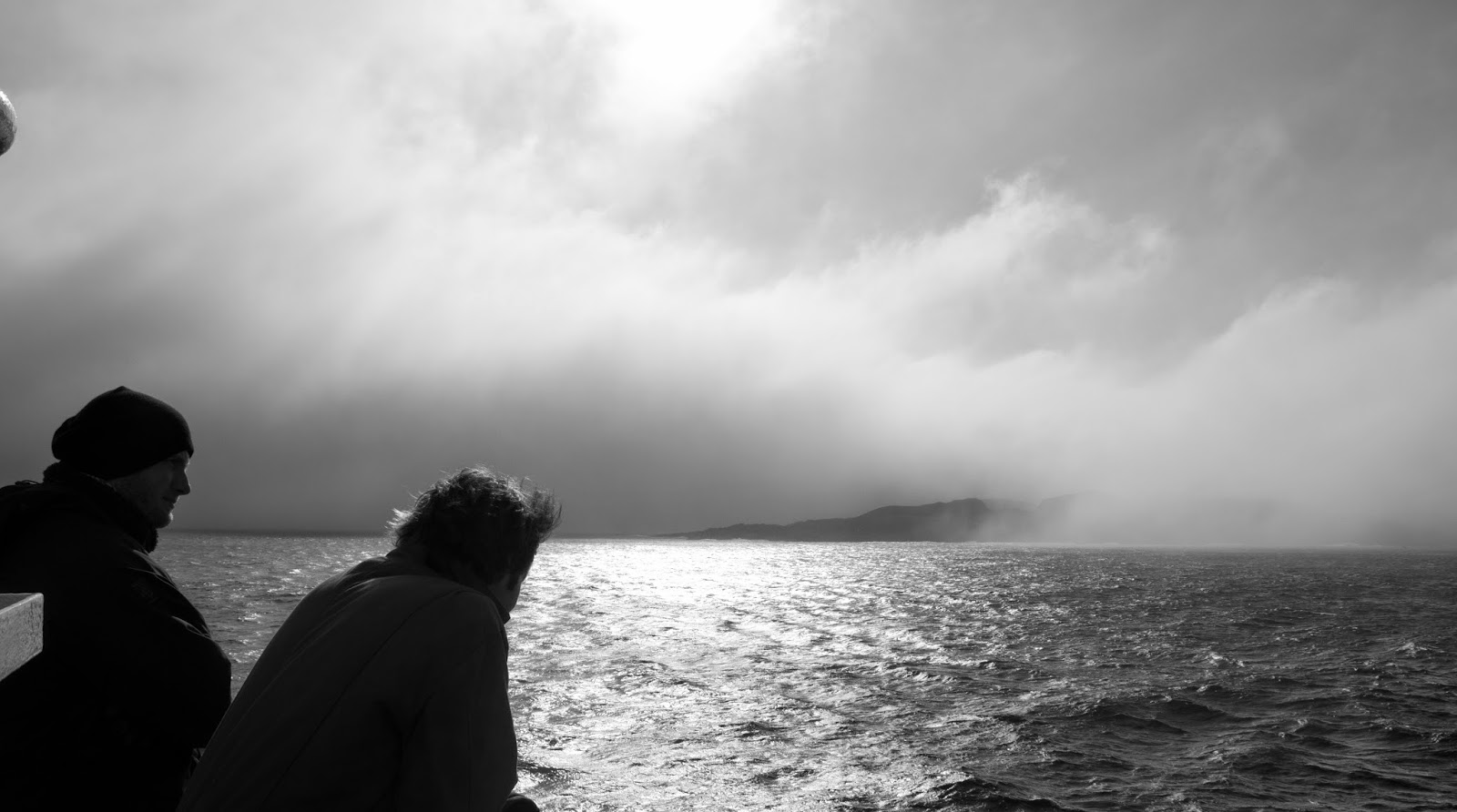
We had hoped for clear views of the island as we set off but as we stood out on deck we laughed at how infuriating the place can be as only the tips of the lowest headlands projected from the grey clouds.

So much for farewell views of the island.
Thankfully in the preceding days we'd had some beautiful clear skies and sun. We'd finished off the ringing of the southern giant petrel and grey-headed albatross chicks, I'd completed a long-held ambition to walk the length of the island along the spine, taking in the five major hills, and we'd popped down to the bottom of the macaroni penguin colony. Even after two and a half years there were still new experiences and sitting at the base of Big Mac while all the penguins charged past and leapt into the sea felt significantly different to past experiences watching them all pile out onto the land. Maybe it was pondering my own departure.

Macaroni penguins heading off to sea.

The view of Bird Island from the very top, looking across Bird Sound to South Georgia mainland and, off to the right, Willis Islands.
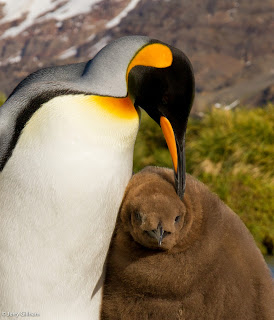
We had expected a slow trip round to King Edward Point on the South Georgia mainland, but within a few hours, just after darkness had fallen, we were there. That meant a reunion with various friends but most excitingly Steph, the B.I. albatross assistant from my first year and a half. It was great to see her, now working there as the predator scientist, and the next morning she took around the coast to Penguin River where there was a small group of king penguins with a few large, fluffy, brown chicks. It was a beautifully sunny and warm day and we got great views of the mountainous interior of the island as well as the wildlife yet to depart for the winter.

King penguin chick looking much too warm in all that gear.
The chick getting a careful preen from an attentive parent.
Curious about my rucksack which, as I've used for work, no doubt smells of penguin already.
The true king of South Georgia.
In the afternoon we got further chance to explore the pass over to Myviken and Grytviken, the museum, the church and Shackleton's grave.

Petrel had, in earlier times, been used to deliver supplies to some of the first teams to set up a base on Bird Island.
Abandoned whale processing plant.
Does whale oil have a sell-by date?
So different from Bird Island; we took a path (a path!) up the tussack-free slope (walking is so much easier here).
We could not believe how clear the skies were. Compare to the earlier photos looking back at Bird Island.
One of this years fur seal pups reclaiming whale-bone relics outside the museum.
The mirror-calm waters of Gull Lake.
That evening there was a big barbecue celebrating the beginning of winter for the K.E.P. staff. Departing along with us were around 40 others; summer staff from the museum and representatives of the South Georgia government, builders and the restoration project team that had completed the (hopefully) final stage of the rat eradication project.

Loading up the helicopters.
King Edward Point the following morning, taken from the cross Shackleton's men erected in honour of The Boss. Beyond the K.E.P. accommodation towers the ship that bears his name.
Before departing the following day we managed an amazing excursion as one of the boatmen kindly took us out across the bay to the base of the nearest glacier. We approached carefully, creeping through the broken chunks of ice, getting ever closer to the huge wall of blue-white slabs and cracks. Stopping the required safe distance from it we bobbed around for a while admiring its size, worrying about the extent to which it has retreated in the last decade and waiting for chunks to fall off.

Cian, Steph and Jess - family day out!
Approaching the glacier; the boatman's view.
A pair of shags skirting the edge.
Too large and impressive for a photo to do it justice.
It was a great way to end our time on South Georgia and as we headed off that evening, waving to the small team of eleven left ashore, we had all decided to enquire about jobs down there.

Looking back to the jetty and a colourful goodbye.
There were some rough seas on the way back but by now I know how to deal with them to avoid seasickness: make sure you've a bottle of water and plenty to read or listen to and stay in bed. By then end of the second day I was able to make it down to grab a very quick bit of food and by the third, when the swell had calmed down a bit, I was able to help out cleaning in the kitchen and get out on deck where we saw a couple of distant whales and some dolphins swim right under the pointy end.

End of part one.


Tuesday, 31 March 2015

BAS webdiary

I'll try and post more photos and a post-script when I return to the UK, but with just two weeks left on Bird Island I am busy making the most of my time, packing, and trying not to think about leaving.

I wrote the March web diary for the BAS site that sums up what we have been up to this last month and many of my feelings about leaving. Click here for that.

Jerry

Sunday, 8 March 2015

Penguin counting

This has been a busy month with the penguins. Al and I, with plenty of assistance from the others on base, have been out counting and weighing chicks across the whole island.

First up came the gentoos. There are 7 separate colonies containing between 200 and 1500 nests (counted at the end of October). The beauty of counting nests is that they don’t move around, whereas young penguins do. Especially once they’re large enough for their parents to leave them and head off to sea to feed. While awaiting their return the young ones crèche together in large, noisy and smelly (though undeniably cute) groups. The largest of these groups can contain several hundred chicks and require some co-ordination of counters.

We’ll try and position ourselves so we’ve a good view of a group, but also so we’re preventing them from running off or mingling with other groups. Then everyone counts as accurately as they are able. Chicks do move around but you do your best and hope that those missed are made up for by any double-counted. When done everyone calls out their figure, like a chaotic bingo hall, and if close enough we’ll move on to the next group. In most cases we aim to have at least six counts, with no more than 5% variation.
Assembled to count a group of gentoo chicks.

As we know how many occupied nests there were from the October counts we can say how many chicks have survived per nest. Gentoos lay two eggs though of course not all survive. A productivity of 1.2 to 1.5 would indicate a good year.
Stopping for lunch at the edge of the colony, it soon becomes the centre of the colony as the chicks head over to investigate.

Similar counts are carried out with the macaroni penguins, although with only one chick per year their productivity is naturally lower. This may be a product of their different behaviour, specifically foraging further from the colony for food. When entering the smaller colony, Little Mac, penguins cross a gateway that can identify and weigh them. An individual can typically leave the colony in the morning 500g lighter than it arrived the previous night – all food passed on to the chick, not bad for a 4kg bird!

We also weigh the penguin chicks at a specific age each year. Weight is a good indicator of general health and many birds are weighed prior to fledging. For the penguins this requires a team of volunteers willing to get muddy and smelly as the chicks have to be caught in a net, put in a strong bag and weighed on a spring balance. It takes less than a minute before they’re running back into the mass of fluffy compatriots.
Still a bit fluffy, young gentoo chicks taking their first steps into the sea.

The penguin chicks are now starting to leave. The macaronis clear the colony within a week, disappearing off to sea while their parents will return in a week or two to moult their feathers before spending another winter in the ocean. The gentoo chicks spend more time familiarising themselves with the water; wading in and putting their faces below the surface then getting freaked out and running back onto the beach when they get knocked over by a wave. Gradually they get more accomplished and start swimming, though often are too fat to dive underwater properly, needing to lose some weight as they develop their swimming muscles.

Not only are there waves, the young penguins also have to deal with over-playful fur seal pups, themselves just getting used to the water and inquisitive about anything near them.

As they lose their downy feathers and a little fat they become more streamlined and start to look like proper penguins. They spend more time in the water and start heading further from the shore.

Jerry

Friday, 19 December 2014

Spring into Summer

Here's a few photos to bring you up to date with what's been happening apart form the seal work (see last post).


First call brought the summer team, and one lonely King Penguin. 

Left to right: Cian (old seal assistant), Al (new penguin & petrel assistant), Robbie (new tech), Sian (new seal assistant), Lucy (new albatross assistant), Jaume (senior seal scientist), Richard (senior seabird scientist), Jess (old albatross assistant), Adam (base commander) and me (old penguin and petrel assistant).

Over the summer we'll be passing on all our knowledge and experience of the long term monitoring duties.


The Gentoo Penguin chicks are almost all hatched now and some are almost large enough to be left alone while the parents head off to sea to feed.


The first Northern Giant Petrel chicks are being left alone, at just two weeks old and not much bigger than a handful, as both parents forage for food. Our daily rounds, checking on breeding adults has finished now and we're just doing weekly checks looking for failures.

.

 The Brown / Subantarctic Skuas are mostly sitting on eggs, though a few now have very cute chicks. We've been checking on ringed birds in the study area, making a map of their nests and recording which adults are present.


Blue-eyed Shags are another bird that are hatching chicks, these ones sadly not so cute as they're born bald and blind. We've been counting colonies on the outskirts of the island - a great excuse to get out to some of the less-well-visited spots on good weather days.


White-chinned Petrels are occupying their burrows. Later in the season we'll be attaching tiny tracking devices to a few, so have been going round checking for occupied burrows - lying in the tussac and reaching down into these dark holes, expecting a sharp bite for our intrusions.


The Wandering Albatross are starting to lay eggs. From Christmas Eve we'll spend a week intensively covering every patch of the island, recording the location and identity of each breeding pair.


Many that aren't yet breeding are loudly displaying, impressing each other with their calls and their amazing 3m wingspan.

Jerry.

Friday, 12 December 2014

Fur Seals

Apologies it's been so long since the last update. We've been hectic busy here with the spring arrival of the penguins, petrels and albatrosses as well as the summer staff – the returning base commander, new technician, a couple of senior scientists and our replacement field assistants. We'll be spending the next few months here working with and handing over to them.

As I was away at this time last year I missed one of the unique experiences of Bird Island; the fur seal season. This started seriously around the beginning of November when the big males started establishing territories on the beach. At 2m long and weighing around 150kg they are by no means the largest seals in the sub-Antarctic but they will not give ground to anyone. As they are more like sea lions than the phocids (elephant and leopard seals as well as the grey and common found around the UK) they are very quick and agile on land.

Charging up river, a male Antarctic Fur Seal.
A male arriving at a crowded beach will have to charge up the river (where no one holds territory) fighting off other males from either side. If cornered he will try and be repelled by a demonstration of superior size, but it won't take much for them to start fighting – biting and thrashing – and the majority have scars somewhere on their upper body.

The males are holding out for the return of the females. They face an equally difficult charge up the beach as they will try and be herded into harems. The largest males with the best locations will have the best chance of attracting and keeping them, outside our window one big guy is keeping his eye on 31 ladies and their pups.
The males can weigh as much as five times the weight of a female. They will typically hold their breeding territory for 20 to 40 days, during which time they will largely rely on the food reserves stored in their body fat.
The pups are born within a few days of their mothers returning from the ocean. Cast an eye over the colony at the right time and it won't be long until you see a female writhing round and giving birth to a little puppy that quickly shakes off its birth sack, opens its eyes and starts crying for food. There's a lot of calling as the mums and pups bond with each other as it's not long (about a week) before the former head back to sea to feed and when they return they need to recognise their young by call and by smell.
Female and newly-born pup taking its first look at the world. 
A female working out which of these two attention-seeking puppies is actually hers.
Once left alone the pups start to interact with one another, climbing, sniffing and play fighting. If there's no one else around they will happily play with their own flippers.

Dreaming of milk, a content pup.

Less than 1% of the pups are born blonde. With very few natural predators (the occasional leopard seal or orca) they tend to survive as well as the more typical black ones though they stand out more.

A stand off between a pair of puppies enjoying the chance to play while their mums are away.

A definite winner in this little battle, though the loser was straight back up for another bout.


95% of the world population of Antarctic Fur Seals Arctocephalus gazella is based around South Georgia with population estimates of 1.5 to 4 million. This has hugely increased in the last 50 years, by which point they were nearly hunted to extinction. Bird Island, being largely inaccessible, was one of their last strongholds.

Much of the science and research being done on these species focuses on finding out where they feed, what they're feeding on and how keeping track of how healthy the population is. Other projects have focused on their genetics and learning more about mother-pup interactions. I've been helping out over on the special study beach where the pups are weighed and samples of their umbilical cords are taken for genetic analysis.  

While some pups put up much more of a struggle than one would expect of their 5kg frame, others fall asleep in your arms.


Jerry.