Friday, 25 September 2015

Back at BAS

I started back at the British Antarctic Survey a month ago in my new role as Station Leader for Bird Island. Life has been pretty hectic since then as the other new SLs and I have found our days full of training courses, document reading and planning for the upcoming season. A whole range of topics have been covered from people-managing skills to the computing systems to managing major incidents. The latter has tested our responses to some pretty daunting scenarios; buildings on fire, planes falling out the sky and major oil slicks. While slightly terrifying they’ve also been extremely valuable in increasing understanding and confidence in what we can do to mitigate problems, how to deal with them and how to manage the station and personnel through the good times and hard times.

Three years ago I arrived at the pre-deployment training week at Girton College with little idea of what to expect and spent my time trying to absorb as much information as possible, trying to work out how much was relevant for my job and my destination. This year I turned up as the go-to guy for questions on Bird Island, feeling much more confident in my role due to experience down south and the training in Cambridge. I tagged along to most of the lectures and discussion groups as there’s so much I still don’t know, especially about life on the bases further south, and I was also able to pick out a few of the most relevant points and reiterate them to my team.

Oil spill response and fire safety were followed by the first aid training. I’m up to date with this so popped back into the office for a few more bits of paperwork before heading back to watch the riotous scenarios the teams are expected to deal with, complete with very enthusiastic acting by the victims. As in my first year the great thing about having everyone together is that you get to meet people from so many different backgrounds, with a large range of jobs, all excited about heading to Antarctica.

The official pre-deployment staff photo 2015

At the end of the week everyone departed and I accompanied the folk who will be heading south for the whole year as they went up to Derbyshire for winter teams training week. I last did this in the year termed ‘rainageddon’, such was the apocalyptic level of mud generated. It now takes place in an outdoor centre that is a pretty good representation of a station in that it requires everyone to pitch in cooking, eating and cleaning together.

Pitching a tent. In the rain.

True to form we did get a bit of drizzle but were able to get a bit of shelter to talk about navigation, campcraft, search techniques and basic ropework. 

Replicating blizzard visibility with the bucket-on-head technique. The aim was to find the second bucket.
Making a pulley from simple climbing kit.
Testing the effectiveness of the above pulley.
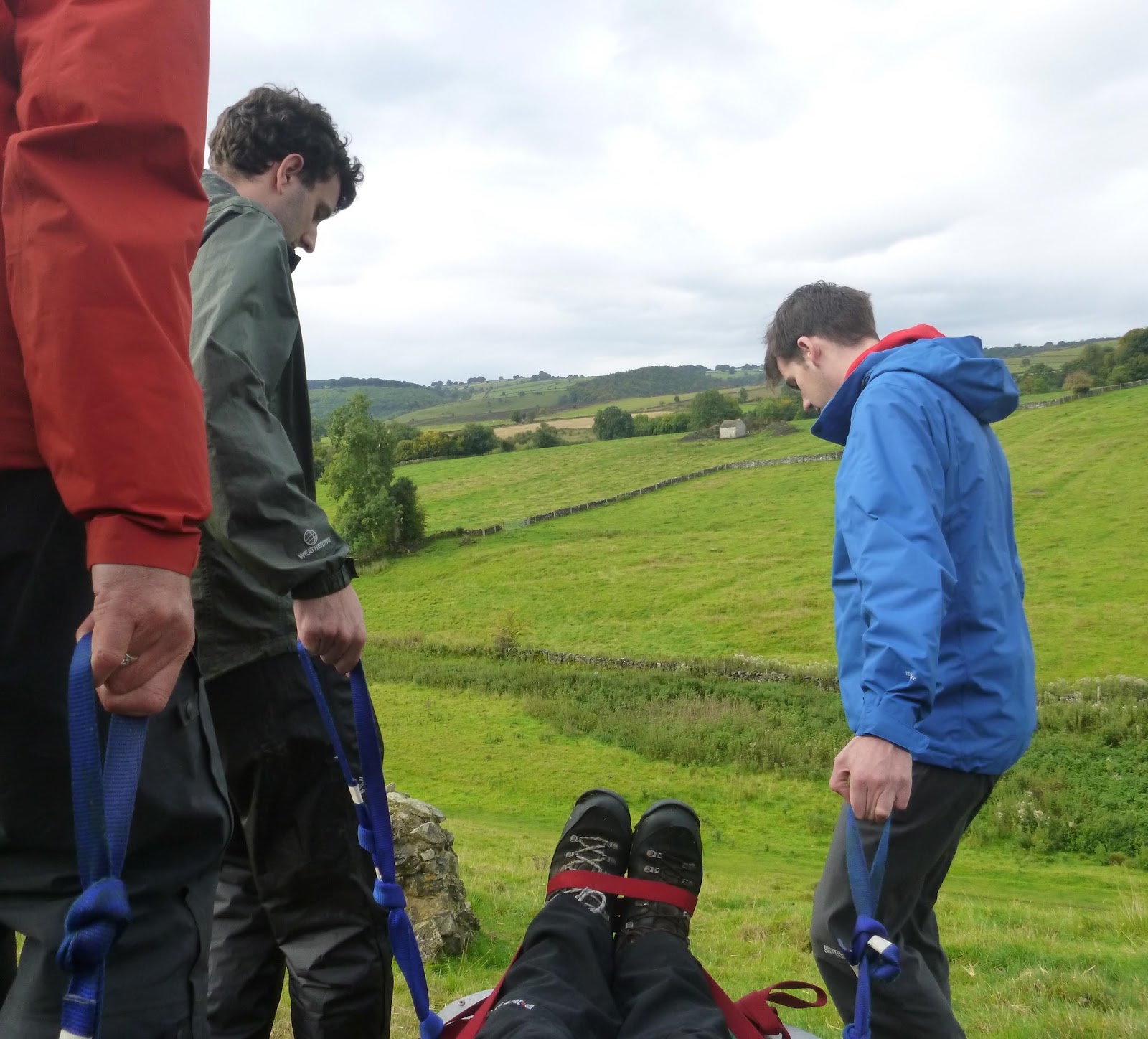
There’s only so much that can be taught indoors though so we managed to get people out to navigate around the campsite and the moors above Curbar Edge before testing their skills on the high ropes course. As has happened a few times recently I played the casualty in a rescue exercise, this one involved me being lowered down and then hauled back up a steep slope on a stretcher.

Putting together a stretcher and anchor system.
The view from the stretcher as we headed off down the slope.
With the sun out we headed up to the moors above Curbar Edge for more navigation practice.
Lunch break.
Learning rope ascending techniques with a couple of jumars on the high ropes course.
Taking advantage of the high ropes course.
Just hanging about.
All roped up for ascending and descending.
Bare feet or wellies... a test of optimal climbing footwear.
Following the excitement of all these group bonding exercises it’s kind of down to earth with a bump as everyone goes their separate ways and I head back to the office for more courses. I can’t wait to head off south again in a little over a month, but still feel I’ve a lot of preparation work to cram in before then.

Relaxing on one of the climbing walls.
The hugely enjoyable end-of-course barbecue.

Friday, 28 August 2015

How to get a job in conservation.

I have worked in conservation for about ten years now and have often been asked about the best ways to get a job in the field. 

This blog is an attempt to answer some familiar questions and provide some guidance for others wishing to pursue a career in this sector, based on my personal experiences and from chatting to colleagues. It is by no means the be all and end all of ‘getting a job in conservation’ and no doubt you will get different advice from many other sources. I will try to respond to any questions and welcome comments from anyone wishing to contribute their own advice.


What do you want to do?

It is important to say that ‘working in conservation’ can cover a large range of career opportunities, and many colleagues I know have switched from one to another. Here are just a few:

Academia – carrying out novel research to promote our understanding of a species or system in order to more effectively preserve them. Usually associated with a university and PhD work.

Research assistant – often the person that does the fieldwork for the above academic. Involves more time getting dirty in the field, close to the species or ecosystem being studied. Less involved in the writing up and will frequently be on a short contract. Often requires a postdoc or significant experience.

Estate worker – carries out important manual work on reserves. Could be anything like path maintenance, reed-bed transplanting, pond creation, woodland management. A good, practical, muddy job with the rewarding aspect that you can often see your work directly benefiting wildlife.

Wardening – will generally involve a huge range of duties from dealing with the public and special interest groups, to manual work on your reserve, to wildlife monitoring. Many reserves have seasonal wardens to coincide with peak times for visitors and wildlife.

Public relations – could involve promoting a particular reserve or company, or focus on public interactions such as educational activities with school groups.

Policy - You want to make a real difference? Get into policy. The thankless task of assessing all the science and then presenting a plan to someone who doesn't understand or has a different agenda. I have nothing but respect for the activists and policy-formers trying to influence change on large scale.


My conservation career

Here is a brief review of the path I took to get to where I am now:
I have always had an interest in wildlife and the outdoors and was sure I wanted a job relating to that but didn’t know quite what. After school I took biology, chemistry and geography A-levels and then studied straight biology at university, with mediocre success. Following a research masters in science of the environment I was ready to move out of academia and into the real world.
After what felt like a long time volunteering I got my first conservation job as a seasonal warden on the Farne Islands, Northumberland and fell in love with islands and seabirds there. After a few years I continued the wardening work down in south Wales, to Skomer and then Skokholm islands, being responsible for overall running of the latter. In 2012 I got a dream job with the British Antarctic Survey to work as a zoological field assistant, collecting data on penguins and petrels on Bird Island, South Georgia.


Qualifications

Take a look at environmental recruitment websites such as countryside jobs service, environment jobs or stopdodo and you will see many asking for a degree in a relevant subject; ecology, environmental management, conservation science or such like. I studied straight biology as I was unsure of the career I wanted and thought (probably rightly) that a mainstream science would offer plenty of alternatives at a later date.
Prior to entering university I would say biology is an essential A-level subject and that one or both of chemistry and maths in support would be highly advantageous.

If university is not for you that shouldn't rule out any but the jobs in academia. There are many institutions offering courses in land management that will often give you a variety of practical skills to go alongside the theory.

Having said this, I have worked with people who have arrived in conservation from many different backgrounds: art school, accountancy and bus driving are three that spring to mind, and that leads me to my next point...


Volunteering - the most important thing!

It is an unfortunate fact that it is very difficult to get a job in conservation without some volunteering experience. I say unfortunate as this can be a disadvantage to those who are perhaps limited by location or finances, however for others it can somewhat level the playing field and filter the great from the mediocre.

Regular volunteering has huge benefits:
  • Increase your knowledge. Spending time with experts on birds, mammals, plants, insects etc. will enhance your ID skills and knowledge. There are a lot of people graduating from university with a degree in ecology or conservation science whose knowledge of British species is surprisingly poor. Spending a bit of time with an expert will really make you stand out from the crowd.
  • Learn new skills. As well as ID skills you may get the chance to learn new practical tasks as some organisations will put their most valued volunteers through courses; first aid, brushcutter use, bat identification. There are other skills you can learn just from hanging around with the right people and groups – bird ringing, vegetation classification. Any of these will make you more employable.
  • Deciding what you want to do. As stated above there are many aspects to working in conservation. If possible spend some time shadowing a few different people on a local reserve. You might find you most enjoy the practical aspect of woodland management or get a real kick out of taking school groups round.
  • Shows dedication. This is where it levels the playing field. While the rich kids are off playing at saving orangutans in Borneo you may be getting covered in mud and rain, moving large chunks of reed-bed from one boggy field to another. But believe me, when employers are looking through CVs, wondering who will work well in their team it is the latter that stands out.
  • Making contacts. As in every single area of employment there is an element of who you know. Working in the seabird & UK islands scene it is rare that I meet someone in the same sphere of employment who I either haven't heard of or don't have friends in common.

I was relatively lucky in that I went through university with the first round of tuition fees, which seem fairly modest now. Although I have since accrued more interest on my student loan than I have paid it back (no one goes into conservation for the money) it was not the financially crippling burden it could be today. I would heartily recommend a few months volunteering in different areas to decide which aspect, if any, of conservation is for you before committing to it as a career.


Who can you volunteer with?

The vast majority of conservation bodies are charities who rely on volunteers to carry out their essential work. The best thing is to get in touch with your local reserve and ask about work parties they run. Purely a personal thing but I always found the Wildlife Trusts most grateful for volunteers and most likely to help develop your skills and employment potential, the RSPB pay their employees a laughably small amount but will often put long term volunteers through extremely useful training courses. The National Trust and John Muir Trust run a variety of work parties in some extremely exciting places.

Volunteering opportunities broadly fit into four categories:
  1. Local, ongoing work. Regular, seasonal maintenance work at a local reserve. I volunteered like this a lot while studying for my masters and while working part time. I would join the local Wildlife Trust group for one or two days a week for whatever maintenance or management tasks were required on the local reserves.
  2. A week away. A longer stint, usually with a group where accommodation and sometimes food will generally be provided. A charge may be asked for to cover housing and travel but bursaries are sometimes available for students and unemployed. When I worked on Skomer we asked for a small amount to cover maintenance and improvements of the volunteer accommodation. Groups of up to six would assist with visitor management, wildlife recording, footpath or building repairs. Whatever was needed that week or whatever relevant skills they possessed.
  3. Long term volunteering. On Skokholm I was assisted by two long term volunteers who would be present for two or three months, learning and taking part in all aspects of wardening and island life. As well as these experiences we provided accommodation and would put them through a first aid course. There were some very competent people who passed through that programme and I am pleased to say have gone on to have a variety of interesting jobs in conservation. Both the RSPB and National Trust run similar programmes aimed at developing the next generation of reserve wardens. Competition for these places can be fierce so previous volunteering experience, knowledge and personal connections can be important.
  4. The high-cost, exotic location. There are some good volunteer programmes abroad; I did one in the Seychelles for a few months, recording hawksbill turtle breeding success. For that I think they paid half my flights and provided basic accommodation. However, many of them charge a lot of money and I would try and contact someone else who has volunteered with them to find out what they got out of it. Did they genuinely get some important skills and experiences or did they just have a fun holiday while the company only wanted them for their money?
Many of these are now advertised as full jobs would be on sites such as countryside jobs service.


It can be tough...

Conservation is a growing interest as people recognise the value of the natural world, however that interest is not necessarily shared by government, particularly this current one, who will always cut environmental funding rather than investing in it. Hence conservation bodies are squeezed further and further, many operating on a skeleton staff. Jobs, certainly the ones I have been doing, tend to be short-contract, heavily contested and low paid (although I have done ok as usually I have had my accommodation provided).


But it's worth it.

That first job is difficult to get but keep volunteering, keep expanding your knowledge, skills and contacts and it will come. Once you get your first job it becomes so much easier and all sorts of options open up. I'm of the opinion that you never appreciate nature so much as when you really spend time amongst it, and that is equally true of a huge penguin colony as the small woodland at the end of your road. Working in any size reserve you find all sorts of life you never realised was there, get to see it change through the seasons and take pride when something you've done improves conditions.

And who knows what amazing sights, species and places you'll end up seeing.

Thursday, 9 July 2015

The Shiants


Arrival on the Shiant Isles
The welcoming sign on the bothy door.

I arrived on the Shiant Isles on 5th June, after a long journey up from Cambridge via Flamborough Head, Inverness, Ullapool and Stornoway. Early that morning we did a last-minute shop for fresh food and loaded our provisions onto the boat; six big plastic boxes full of camping gear, tagging technology and office supplies, three large barrels of food, four big water tanks, two rucksacks loaded with rope access equipment, a portable generator and large quantities of personal gear, all tightly dry-bagged.

As we sped across the Minch the excitement levels were rising as we were finally getting out to the real fieldwork. The chance to spend some time on the Shiants was one of the main reasons I went for this job. Flocks of seabirds sat on the water and watched us pass, while porpoise and a minke whale surfaced close by. It was a calm day but dominated by mist and drizzle that had steadily increased to a persistent rain by the time the Shiants loomed out of the grey; the tall, imposing, sheer cliffs surrounded by puffins, razorbills and guillemots filling the sea and the sky.

My first view of the Shiants.

It was a wet arrival (partly the rain, partly ending up thigh-deep in the sea while loading and unloading) but before long we were drinking tea in the bothy with the LIFE monitoring team and by early afternoon the sun was out, giving us time to set up our tents before the storms of that evening drew in.

What would become a familiar sight; thermals on the washing line.


The Islands

The Shiants are owned by the Nicholson family and a passionate biography of the islands can be found in Adam's book. They are located roughly half way between Stornoway and the Isle of Skye, in the middle of the turbulent Minch. They consist of three main islands and an assortment of smaller outcrops and rocks. We have been working on Eilean an Tighe (House Island) and the larger, steeper Garbh Eilean (Rough Island), joined at all but the highest tide by a narrow shingle isthmus, crossing of which can dictate time spent in the field.

Looking south across House Island; the smaller, lower and boggier of the two main islands. On the near right side you can just make out the bothy. 
Looking north to Rough Island across the isthmus, boulder field and arch.
The imposing Rough Island. The zigzag route up this steep edge takes you from sea level to 135m without much mercy. Down on the causeway the LIFE team are returning late to find a challenging dash across between the waves.

Our base is beside the bothy on Eilean an Tighe. A small but comfortable, dry building with a lovely open fire and nearby water source, we were extremely grateful for its presence in the poor weather that dominated our stay.

The bothy. Due for a re-roof, it did keep us dry and warm.
Sitting round the table for food, drink, warmth and conversation in the evening.
The west-facing bothy catching a superb sunset. Our tents are off on the right and the small spring where we got our fresh water is just behind me.

Around the camp are nesting oystercatchers, pied wagtails and meadow pipits while a small crèche of eider ducks was regularly seen around the isthmus. 

Female eider ducks and ducklings.

Further up the slope, defending their nests with the aggression one would expect, are the bonxies, the great skuas, often competing with the large gulls and ravens for territorial dominance. 

Bonxie calling out a warning.
You get too close to the nest you're going to know about it.

The cliffs are teeming with kittiwakes and auks, fulmars cackle loudly from patches among them and puffins cover the grassy slopes like discarded confetti.

Slopes full of puffins.
More obligatory puffin photos.
Carrying fresh nesting material. With such a wet summer this was a common sight, as were filthy, muddy birds.

The mixture of upland, marshland and coastal plants and flowers means there is quite a diversity of colour amongst the well-grazed grasses, with bright yellow irises and pink/purple orchids the showpieces.

Common spotted orchid, I believe.
Flag iris.

A highlight for me has been regular sightings of eagles; a pair of golden eagles can regularly seen circling the nearest peak of Garbh Eilean, while the mighty white tailed eagles dominate the other side.

A poor photo of a rather tatty golden eagle. Still, you can see that amazing eagle face.

The real star of the Shiants though is the boulder field, Carnach Mhor, surely one of the most amazing places in the world for sheer density of seabirds. 

Looking down at the boulder field. I'm sure it was never this sunny.

It really is like a crowded city as every square meter is packed with birds, eggs, chicks, noise and smell. In little pockets on flat rocks the guillemots huddle together. Down in the cracks and gaps the razorbills make their home while further down still, in the smaller crevices, puffins peer out at you in their inimitable way. Every so often a loud honking reverberates around the enclosed rocks as a shag makes its presence felt.

Shag on the nest among the boulders.

The sky above is filled with thousands of birds wheeling around, wings beating rapidly as they circle their landing sites. At times, such as when a predator flies over or when large numbers are returning with food at dusk, the sky looks so full it feels like a biblical swarm.

Looking upwards from within the boulder field, there's lookouts on every rock and more coming in all the time.


STAR work

See my previous blog for the background to the work I was doing on the Shiants. We were focussing on gathering track data from the larger auks; razorbills and guillemots. 

Razorbill.
Guillemot.

After a few initial teething problems with the devices we are very happy with the data we got back. The tracks are to be properly analysed and published but I’ll try and get an example of the sort of thing we found.

Working late into the evening sealing tags in their waterproof cases.


Additional work

It’s been a busy time on the normally isolated islands as work gears up towards the rat eradication project. The Shiants have been identified as one of the most important sites for seabirds and for seabird potential should the black rats, accidentally introduced years ago through shipwrecks, be removed. This is a large scale project that will commence over winter, though we had a few traps around our camp to keep our food and bedding safe and rodent-free.

The warning sign within the bothy.
A poor, unfortunate, extremely cute eco-terrorist who came too close to our food. That long tail they have is amazing.

One of the key hopes is that the removal of rats will see the return of Manx shearwaters and storm petrels; vulnerable burrow-nesting species who have increased in numbers on other islands (such as Ramsey) where rodents have been eradicated. Happily on our journey back to the mainland I spotted a couple of shearwaters cutting the waves of the Minch, so they are around.

Fulmar.

Along with the RSPB’s LIFE team, who are attempting to record all the vegetation, vertebrate and invertebrate life present on the island, we have been joined at times by a small film crew documenting human-seabird interactions and by Scottish Natural Heritage, carrying out additional monitoring. In particular they have been counting the huge numbers of seabirds, something we got involved with, marking out areas of known active burrows on the puffin slopes then retiring and counting the hundreds of individuals standing out beside them.


Reflections

The above is a lightly edited version of a blog I wrote for the RSPB’s own website (hence the confused tenses) but with better photos. We left the Shiants on 28th June, heading off through rough seas on a nice big boat after helping the large ringing group unload their huge amounts of kit onto the shore.

Though we had reduced the size and weight of our kit, mainly by eating the food but also by losing a few things, I had an extra two bin bags full of plastic bottles, all collected from a short stretch of beach near the bothy. Maybe it’s because I’ve spent the last few years somewhere truly remote where I collected and recorded any debris found, but I was shocked by the amount of rubbish along the shore. Mostly marine debris and fishing gear – buoys, ropes, nets and crates – but so many bottles, lumps of polystyrene and assorted broken plastics. These are a huge problem, not just aesthetically but in terms of being ingested by marine life. It was so depressing to see a remote, isolated, beautiful, wild island so obviously polluted by sheer human laziness.

I just didn't have enough time to build a huge sculpture / wicker man out of it all.

I was sad to leave the islands but looking forward to comforts like a comfy bed, shower (rather than the cold sea) and a toilet (rather than a wave-bashed rock). Time there had been tougher than I imagined, largely the result of a) continual damp, especially boots, and b) a constantly whistling companion. Still, when it was good it was magnificent. I’ve fond memories of sitting round the fire in the bothy in the evenings, chatting with the others who generously shared their wine, whisky and food.

Razorbill preparing to depart.

The afternoons when the sun was out brought out the blue of the sky and sea, the green of the hills and the yellow lichen on the rocks. When it was clear enough you could see all along the Outer Hebrides and down to Skye. Having time to observe the seabirds in such huge numbers, behaving naturally, oblivious to my presence was always a joy and long may it continue to be.

A glorious sunset over the western isles.


Jerry 

Wednesday, 8 July 2015

A new job

Just 36 hours after landing back at Brize Norton Jess and I boarded the sleeper train up to Inverness, ready to start work for the RSPB. That hectic weekend took in a day of first aid revision and a nice day on the Aberdeenshire coast expanding our rope work skills as well as all the contract signing and paperwork. This was all as part of our new jobs as research assistants for the Seabird Tracking And Research (STAR) project. This is the final year of work that has been ongoing for a few summers now, formerly known as Future of Atlantic Marine Environment (FAME), that a number of my friends and colleagues have participated in.


While not indulging in any climbing or abseiling, we will be working on the edges of some cliffs and steep slopes. Places where you'd much rather be properly roped up.


STAR

The aim of STAR, if the title didn’t make clear, is researching seabird behavior - specifically through tracking individuals during the breeding season. The study focuses on five main species (fulmar, guillemot, kittiwake, razorbill and shag) at a large number of sites around the UK and Ireland. A range of lightweight devices that can record a birds global position, dive depth and movement have been deployed and a huge amount of data recovered.

The first view of this data shows where the birds are spending the majority of their time away from the nest during egg incubation and chick rearing. We can see key feeding areas at different times of year, stages of development and between years. Already this has shown how some birds travel much further than was previously thought common or even possible. Further analysis can link this to weather and marine conditions and how these link to poor or successful breeding seasons. Perhaps the most important reason for identifying the key feeding areas is for conservation and protection. Marine Protected Areas (MPAs) are a big issue at the moment and this data will hopefully mean they can be sited in the best places. Similarly offshore windfarms have a large potential for supplying clean, green energy, but they can cause problems for wildlife if built in the wrong location.


In the office

While Jess and Jodie headed up to Fair Isle to start their summer work, Emily and I drove back down to Cambridge, from where we could work in the RSPB office at The Lodge. The journey back was interesting, lets just say that after nearly three years without driving I wouldn't have chosen a 10 hour journey in a van with no rear view mirror and very sensitive brakes.

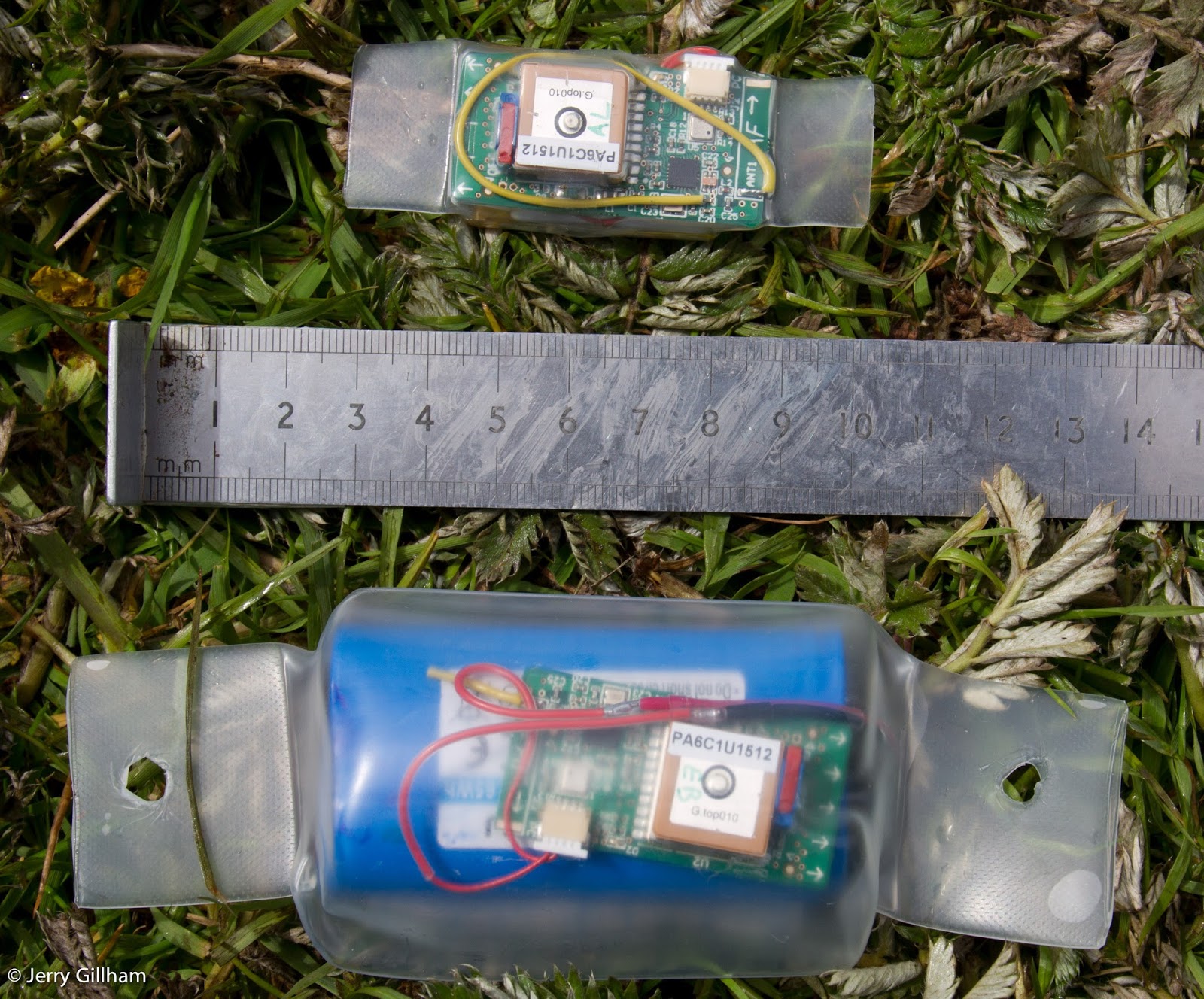
Most of my time down here was spent getting to grips with the new Mataki tags. Unlike those that have been used previously, the key advantage of these cutting-edge new tags is that the gps data they collect is downloaded remotely to a base station, rather than having to recapture the bird to collect the device back. This means significantly less disturbance to the individual and the colony. Depending on how often you want to record gps points the batteries can last from two days to a week, while a combination of immersion in the sea and picking at it by the bird means tag will fall off in 10 days or so.

Mataki tag (top) and base station (bottom). The only real difference is the size of the battery. As it's vital to keep these devices as light as possible they are often just a circuit board attached to a battery, sealed in heat-shrink. The tag here is under 20g, less than 3% of the birds body-weight.
As with any new technology this required a fair amount of testing; learning how the programming works, checking battery life and downloading range. The best way to do this is to set the tags up and attach them to the back of your rucksack when cycling to and from home each day.

Cambridgeshire: flat. You don't need a bike with a large number of gears.

After my time on Bird Island, getting used to spending every day in an office was a strange adjustment. Although I often had office work there I would generally do it first thing in the morning or late afternoon, saving the best part of the day to head out and do my monitoring work. At The Lodge I usually broke up the day by heading out into the reserve over lunchtime. Being among woodland made a nice change as I reacquainted myself with species I’d not seen in years (butterflies, tits and finches) and a few new ones (hobby).

Peacock butterfly.

Distant hobby.


Flamborough Head

At the end of May we got our first real taste of field work, heading up to the reserves at Bempton and Flamborough on the Yorkshire coast. The huge, seabird-covered cliffs are spectacular. Seeing gannets at such close range was fantastic, though it wasn’t them we were there for.

Cliffs packed with auks and kittiwakes. Bempton and Flamborough looking busy.

Early in the morning (extremely early in the morning, like 3am early) we awoke and headed to the cliffs. To reduce disturbance we wanted to complete our work before the coast path got busy. When handling the birds we try and stay as quiet as possible and aim to release them in within 6 minutes, studies have shown when these conditions are met the impact on the birds are minimal. 

Sunrise on the white cliffs at Flamborough.

Roped up and sat on the edge of the cliffs at that time in the morning was great. I saw a barn owl casually hunting back and forth along the edge, at one point swooping past me with an unfortunate rodent in its beak. With the full moon dropping over the horizon to my right as a deep orange sun rose on my left I felt like was in the perfect location for something dramatic to happen. You know when you look up at a star-filled sky sometimes you feel a small and insignificant part of the universe? Well at that time and place I felt the opposite. Like Zaphod beating the total perspective vortex.

Jerry