Showing posts with label macaroni. Show all posts

Tuesday, 10 May 2016

Happy Birthday David Attenborough

Sir David Attenborough's 90th birthday was celebrated down here on Bird Island with a cake, a raised glass and a few episodes of Life In The Freezer. The second one in particular, 'The Ice Retreats', contains a large amount of footage from Bird Island; all the albatross and penguin shots are familiar.

Here's a few screenshots of David Attenborough on Bird Island, standing in the middle of Big Mac, one of my key work locations when I was Zoological Field Assistant for the penguins, rather than the tourist I go over there as now. In this sequence he described Macaronis as the loudest and most bad-tempered of all the penguins. At times I have described them in similar, but less eloquent, ways.


All copyright owned by the BBC and photos used without permission. Check out their series Life In The Freezer or the more recent Frozen Planet for the best impression you can get of Antarctica.

Obviously much has been said regarding David Attenborough's work and life but it is probably worth repeating that, outside of immediate family, he has probably been the biggest influence on me and many others down here. Not just the scientists studying the charismatic megafauna but anyone who grew up wanting to travel, explore and witness all the amazing sights the Earth has to offer.

Bird Island folklore says that the old jetty bog was his favourite toilet in the world. Unfortunately when the jetty was rebuilt this had to be removed from the end and placed near the main base, but it is a mark of respect that it is still standing, admittedly only used as a store currently but no one can bring themselves to tear it down. You can't destroy David Attenborough's favourite toilet!

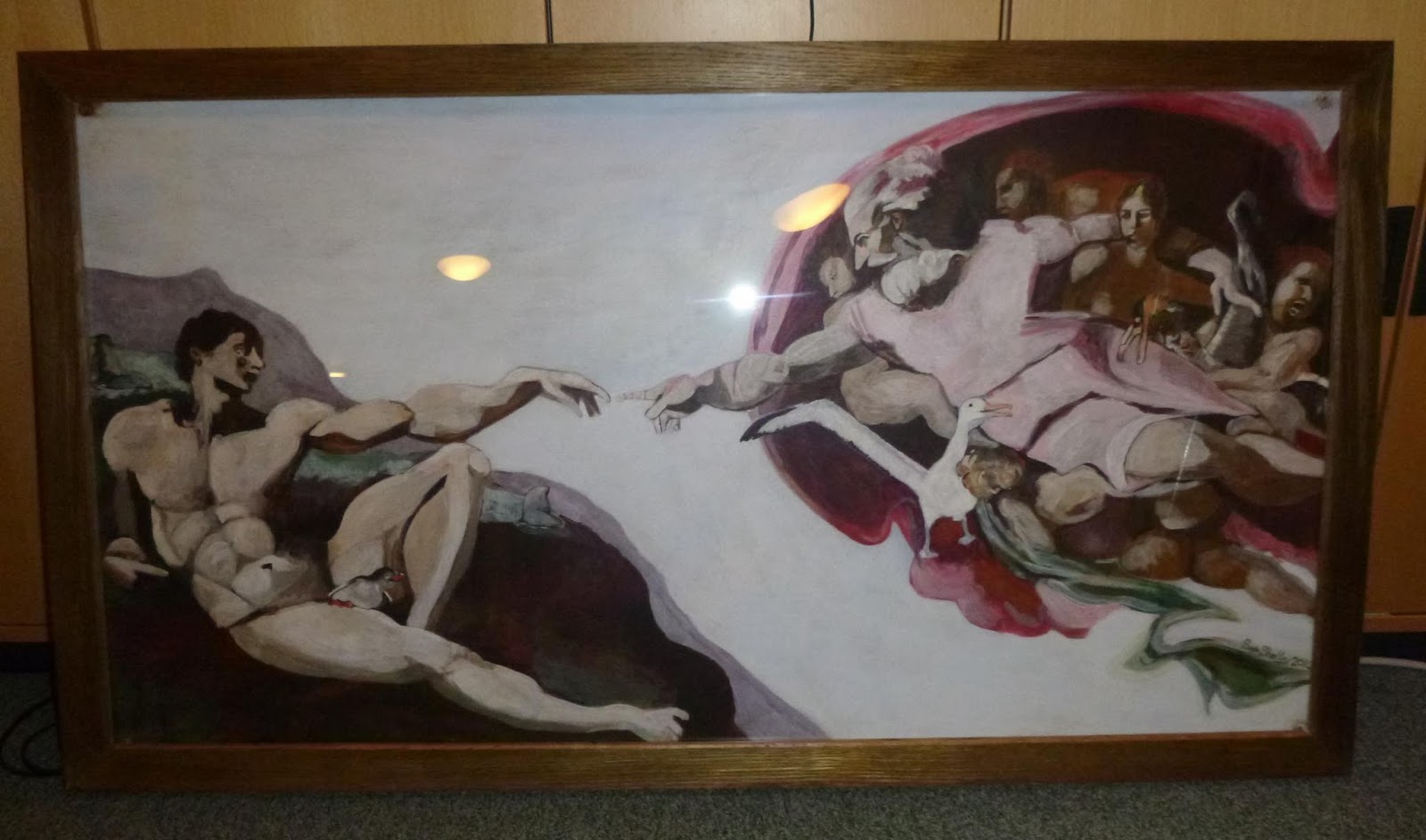
Time is getting the better of it however and this season we have started working on preserving the unique features. On the ceiling was a painting done by a previous Station Leader, Sam, in 2010. A recreation of the roof of the Cistine Chapel with a few Bird Island natives splashed across it, my favourite being the gentoo penguin chick on Adam's lap. The painting has been taken down, cleaned up and framed, ready to take pride of place on the wall in the lounge.


Jerry

Friday, 14 March 2014

Wildlife update 1: Penguins

Gentoo Penguin

Having started to hatch just before I left, it was pleasing to return to see good numbers of large Gentoo chicks covered in dense down. This has been shed as their adult feathers poked through and by mid-February most of them had explored the edge of the sea. This tended to take the form of wading into the sea to about waist depth, falling forward and flapping wildly on the surface. They'd try a few dives but at first most are carrying too much body fat so just flail on the surface. That doesn't last long before they turn and run back onto the beach where their less adventurous pals stare at them like they're expecting tales of the wide ocean. With time the fat is replaced with muscle, helped by vigorous flapping on the beaches, and they start to venture a further and further into the water, diving and chasing each other around.

Taking a break during gentoo chick counting for a quick lie down. This curious chick, almost fully moulted but with a little down left on the back of the neck and the flips, was curious enough to wander over and try to remove my glasses.

Throughout all of this they are still being fed by their poor parents. The adult exits the water and walks up the beach calling. It doesn't take long before one or two chicks, frequently the same size as the parent and often fatter, come charging toward it. The adult turns and runs, often heading right down to the waters edge before allowing its young some food, hopefully a belly-full of regurgitated krill. The running away from the chicks draws them closer to the water, maybe an encouragement that they should be out feeding themselves. It also ensures the fitter, healthier chick, the one that can keep up, gets fed first; an important strategy to maximise the chances of success in a lean season.

Young penguins enjoying the wave pool - one of the more sheltered bays - before they head for the open sea,

My work with the Gentoos has mainly been to count the number of chicks in all the colonies. With approximately 4,000 on the island they have had a reasonable year. Chick health is roughly worked out by weighing them (not all 4,000). By comparing numbers and weights to those collected every year for the last few decades we can look at long-term trends in these species that are key indicators of the health of the whole Southern Oceans.

An adult being harasses for food by its two strapping chicks,

There is another, even more glamorous part to my job with the Gentoos. A few evenings after dinner I donned latex gloves, took some bags and a spoon and headed over to Landing Beach. There I positioned myself near the colony, with a good view over many adults.
I wait with baited breath for this one moment.
Over to the left! It happens! A penguin does a poo!
Brandishing my spoon I hurry over before the Sheathbills can get to it and scoop up as much of the poo as I can, putting it in a little bag which I seal and put in a larger bag.
Back in the lab I will label and freeze this before returning it to Cambridge.


Me barely able to contain my excitement at a particularly good bit of gentoo poo. (Hannah's photo).

Rather than some weird, long-range-mail based campaign of abuse, this is part of an experiment to try and determine Gentoo diet through isotope analysis.


Macaroni Penguins

Like the Gentoos the Mac chicks have also gone from small balls of fluff to fat balls of fluff to sleek swimming machines. Where the young Gentoos get to splash about a bit in the shallows that's not really an option for the Macs as, with big waves breaking against the steep rocks, getting in and out is an art form that the adults often fail, getting washed down the big beds of kelp.

A creche of fluffy young penguins with a few adults on guard around them.

A fairly young Mac (note the short eyebrows) wearing a sort of body warmer made out of its old, unmoulted feathers. 

Counting and weighing the chicks is again the priority in terms of monitoring but there's several non long-term projects that I've been getting up to. One recent one is observing behaviour during moulting, which is nice as I just sit and watch the colony for a while, recording how often the birds preen themselves and how often they preen their partner.

A whole load of jumping Macs heading back for the colony.


"You've got to fly like an eagle... leap like a salmon... etc..."

The scramble to get out when a good wave gives you a leg-up.

The one that mis-times it ends up frantically paddling upstream while moving down.


Sunday, 27 October 2013

Return of the Macs

While the Gentoo Penguins have been around all winter, although in much larger numbers recently, the Macaronis have been out at sea since April.

I've been out preparing for their return - painting and measuring transect lines within the colony that we'll use to estimate numbers and setting up the gateway that weighs them as they return to feed young.

The return date of the Macs is pretty consistent year to year so I knew that when I was out doing some measuring there was a good chance I'd see the first one back. And so I did. There it was, standing half way up the colony looking nice and clean with big impressive eyebrows.

Numbers seemed to double each day for the next week until the colony was swarming and bustling with birds. These will be the males, returning first to establish sites and build nests. The females are out at sea still, feeding up so they've got the energy reserves to lay their eggs. They'll be back in the next fortnight though.

It's been pretty rough the last few days with some big swell and waves smashing over the rocks. That hasn't stopped the tough little Macs though. Neither has the Leopard Seal patrolling at the bottom of Big Mac. You have to admire their resilience as they ride the waves up the rocks, struggling to get a foothold before it ebbs back and drags them down past the kelp and into the danger zone.

Once up on the rocks they have a shake and a preen. Check their feathers are still in order and they're looking good and then start walking up the narrow route onto the wider 'motorway' up through the colony and back to their nest site where they can start shifting rocks around and arguing with the neighbours.

Shock at seeing the first Mac while out measuring the transect (Hannah's photo).

A late evening at Little Mac with the first 60 males back.

Looking over at the big waves crashing against Big Mac.

A group of Macs charging back home.

Getting washed up the rocks.

Spot the penguin struggling not to slide back down.

Made it!

Another group make the run.

Penguins crashing against each other in the maelstrom.

Once ashore meeting friends and preening,

Heading up to the colony.

One at a time in some places.

Trekking up into Big Mac.

Getting comfortable on it's nest site.

Little Mac with several hundred penguins back, but with many more still to come.


Jerry.

Saturday, 6 April 2013

First Winter Blog


All change at Bird Island

I arrived back on 14th March. Later than planned due to bad weather, but that meant I had a chance to see KEP again, this time in the snow, a lot of which had fallen while I was out feeling rough at sea. There was a decent amount of snow remaining when I got back to Bird Island and I had time to race up the valleys to play in it and appreciate being back while it was sunny and the ship's crew were deciding on a plan of action for last call.

The snowy La Roche and South Georgia from the top of Gazella.
Ruth, Jen, Jon, Tamsin and Iain (who I'd only briefly crossed over with) headed off later that afternoon. A strange and emotional departure; we weren't sure if they'd return the next day or if that was it. To go from living and working so closely with people and then having half of them suddenly leave is a bit daunting, particularly when they know so much about the place and the work.

Our last view of the others as they are shipped off to the RSS Ernest Shackleton  and return to the UK (via a trip down to the peninsula).
They didn't return, just a few of the crew came back in the RIBs to pick up outgoing cargo and waste as well as dropping off a few bits of cargo, fresh veg and what post they had for us.

It's taken a bit of getting used to running the base with just four people – cooking comes around twice as often, there are more cleaning jobs each, the place can easily feel a lot quieter if a few are out working. We've not been able to properly settle into the more relaxed winter regime yet as there's still a lot of work going on:


Penguins / Geeps

The Northern Giant Petrels are fledging, while the Southerns are not too far behind. I'm carrying out weekly rounds to check on them and will soon be out ringing the Southerns and sending a few on their way with tiny GLSs so we can find out where they travel to and feed in those important few juvenile years.

Large Southern Geep chick in the snow.
There's not too much penguin work at the moment as all their chicks have fledged. Gentoos are finishing their annual moult spread sparsely around the beaches, while the Macaroni colonies are full as the adults moult before heading out to sea for the winter. We managed to take advantage of a clear evening to head down to the bottom of Big Mac to watch them arriving and departing, riding in on the breaking waves and struggling through the kelp.


Macaroni penguins emerging through the breaking waves onto the rocks.
Following the confident one on their way back up through the colony.
Big Mac at sunset.


Albatrons

Black-browed and Grey-headed Albatross chicks are getting pretty big now, not far off fledging. I've been out helping Steph weigh and ring them. By weighing on specific days after hatching we can study how they progress and how healthy the population as a whole is. It is also very useful data for predicting how future changes to food supply will affect these species.

Black-browed Albatross chick looking angry, as they all do.
The Wandering Albatross eggs have hatched and the first chicks are starting to be left unattended, their parents heading off to sea and only returning to feed them. It was the monthly census on 1st April and I headed over to Farewell Point on the east end of the island, checking nests on the way. It was a cold but clear day and I took advantage of this and the early start to head back via the ridge at the top of north cliffs. This tiring and walk and occasional scramble was well worth it, offering some magnificent views across Bird Island and South Georgia. I finished up with my first ascent of La Roche, at 356m the highest point on the island by some distance.

Wandering Albatross without parental support.

Views along the ridge - steep and spectacular.

Seals

The seal work continues to fill days, with the team of three dropping to one with the rest of us drafted in to try and fill their place. The beach is a lot quieter as adults and puppies alike spend more time out at sea and Hannah spends all day walking up and down the valleys looking for specific puppies to weigh.


Back on base

It's starting to feel like winter as the nights draw in – it doesn't get light until about 9 and is dark by the same time in the evening. As we've all still got loads of work to do we only manage the odd evening off. The best one so far was Craig's birthday. He decided on a Hawaiian theme, complete with barbeque and hot tub: a great way to kick off our winter celebrations.

Not BAS-issue winter clothing.
"If I keep telling myself it's tropical it will be."
An unexpected and lost visitor - Cattle Egrets aren't unknown here, in fact one a year is about average, but they still look very out of place amongst the penguins and seals.

A rare clear sky offering amazing views of the Milky Way.

More regular photos and updates at: www.blipfoto.com/JerryATG

Jerry